Swordtail
Xiphophorus hellerii
Active livebearer with a bladed tail · Beginner

- Lifespan
- 3-5 years
- Adult size
- 10-14cm / 4-5.5in
- Min. habitat
- Aquarium 95L+ / 25gal+, heated and filtered
- Social needs
- Social; keep in groups
- Diet
- Omnivore (flake, pellet, veg, live foods)
- Time
- 15 min daily; weekly water change
- Cost
- Medium
Overview
- Swordtails are lively livebearers from Central America, named for the long blade extending from the lower tail of mature males.
- Closely related to platies, they are larger, more active, and need more swimming room than their compact cousins.
- Hardy and adaptable, they come in red, green, pineapple, and tuxedo varieties.
- They are strong swimmers and accomplished jumpers, so they suit keepers who provide length, a secure lid, and stable, slightly hard water.
Housing
- Their size and energy call for a tank of at least 95 litres (25 gallons) with good length, kept at 22-28C (72-82F) in hard, alkaline water and filtered to keep nitrate low.
- Open swimming space matters more than height for these powerful swimmers.
- A tight-fitting lid is essential, as swordtails are notorious jumpers.
- Provide planting at the sides and back for cover and fry refuge while leaving the central water column clear for their constant activity.
Diet
- Swordtails are omnivores that do best on a varied, vegetable-inclusive diet.
- Use a quality flake or pellet base, add spirulina, algae, and blanched greens, and offer frozen or live foods such as bloodworms, daphnia, and brine shrimp several times a week.
- Feed modest amounts once or twice daily, only what is consumed quickly.
- Like other livebearers they tend to overeat and can become constipated on a low-fibre diet, so keep vegetable matter a regular part of the menu.
Health
- Swordtails are robust given clean, hard, stable water, but suffer ich, fin rot, and constipation under neglect or poor diet.
- Steady warmth, strong filtration, and weekly water changes prevent most disease in this hardy species.
- Mass-bred stock can be genetically weaker, so source carefully and quarantine new fish.
- Watch for clamped fins, white spots, or a swollen belly with stringy faeces, signs of parasite or dietary trouble that respond to corrected care.
Temperament
- Swordtails are active and largely peaceful, but mature males can be territorial toward each other, sparring over space and females.
- Keeping a single male, or several with plenty of room and a female-biased group, reduces conflict and stress.
- They are confident, outgoing community fish that occupy open water and rarely hide.
- As ready breeders, mixed groups produce frequent fry, which adults will eat unless dense planting offers the young somewhere to shelter.
A good fit for
- Larger community aquariums with swimming space
- Beginners wanting an active, hardy fish
- Hard-water planted setups
- Keepers who can provide a secure lid
Common mistakes to avoid
- Undersized tanks restricting active swimmers
- Multiple males fighting in tight quarters
- Open tanks letting these jumpers escape
- Low-fibre diets causing constipation
Is your enclosure big enough?
Is this urgent?
In a fish tank the patient is usually the water. Test before you treat — dosing a healthy tank for a disease it does not have makes things worse.
Go now
Today
Soon
Never add a new fish to a tank that is not fully cycled, and never treat blind. A test kit is cheaper than the fish.
This is general guidance for a healthy adult, not a diagnosis. An exotics vet who knows your animal always overrides it — and the time to find one is before you need one.
What it really costs
Setup, monthly, first year and across a whole life, itemised and with the electricity worked out from the actual wattage. Published figures for the same animal disagree by a factor of four, so the calculator shows ranges rather than picking one.
More Freshwater Fish guides
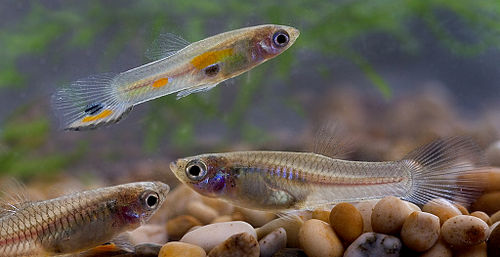
Colourful livebearer that breeds readily

Tiny, colourful livebearer for nano tanks

Hardy, colourful community livebearer

Sociable livebearer that prefers hard water

Colourful labyrinth fish that lives alone

Small orange tetra for nano planted tanks