Endler's Livebearer
Poecilia wingei
Tiny, colourful livebearer for nano tanks · Beginner

- Lifespan
- 2-3 years
- Adult size
- 2-4cm / 1-1.5in
- Min. habitat
- Aquarium 38L+ / 10gal+, heated and filtered
- Social needs
- Social; keep in groups
- Diet
- Omnivore (micro-flake, crushed pellet, live foods)
- Time
- 10 min daily; weekly water change
- Cost
- Low
Overview
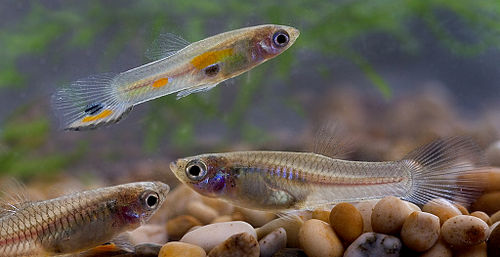
- Endler's livebearers are a close relative of the guppy from the warm coastal lagoons of Venezuela, with males showing orange, green, and black metallic patterning on a small body.
- Pure strains are conservation-sensitive and worth keeping unmixed.
- They are hardy, active, and smaller than guppies, which suits nano and planted aquariums.
- Like all livebearers they reproduce quickly, so single-sex groups or population planning are wise from the start.
Housing
- A cycled, heated tank from 38 litres (10 gallons) suits a colony, held at 22-28C (72-82F) in slightly hard, alkaline water.
- Dense planting shows off their colours and gives fry refuge, while a gentle filter keeps the small fish from being buffeted.
- Endlers stay near the surface and mid-water and tolerate a range of conditions, but appreciate stable parameters and low nitrate.
- A lid is sensible, and avoid housing pure Endlers with guppies if you wish to preserve the strain.
Diet
- Omnivorous and undemanding, Endlers take finely crushed flake or micro-pellets as a staple.
- Supplement with spirulina, blanched veg, and small live or frozen foods such as daphnia, microworm, and baby brine shrimp, which improve the males' colours.
- Their mouths are tiny, so grind dry food finely and feed small pinches once or twice daily.
- Remove uneaten food promptly, as overfeeding a small, heavily stocked tank quickly degrades water quality.
Health
- Endlers are robust when given clean, stable water.
- The usual livebearer troubles, ich, fin rot, and internal parasites, tend to appear only after chilling, crowding, or poor maintenance.
- Quarantine newcomers to protect an established colony.
- Because they breed so freely, inbreeding can weaken closed colonies over generations, so introduce fresh, healthy stock occasionally.
- Watch for wasting, clamped fins, or white spots and respond early with corrected parameters and appropriate treatment.
Temperament
- Peaceful, lively, and constantly active, Endlers do best in groups where males display their colours.
- They are too small to harass tankmates and make good peaceful community fish alongside other gentle, small species.
- They are prolific breeders, and a mixed group will produce a steady stream of fry that adults may eat without plant cover.
- Keep males only to avoid a population explosion, or provide dense planting if you want them to raise young.
A good fit for
- Nano and small planted aquariums
- Beginners wanting a colourful small fish
- Peaceful community and shrimp tanks
- Keepers interested in preserving pure strains
Common mistakes to avoid
- Crossbreeding pure strains with guppies
- Rapid overpopulation from mixed-sex groups
- Overfeeding fouling a small tank
- Inbreeding weakening closed colonies over time
Is your enclosure big enough?
Is this urgent?
In a fish tank the patient is usually the water. Test before you treat — dosing a healthy tank for a disease it does not have makes things worse.
Go now
Today
Soon
Never add a new fish to a tank that is not fully cycled, and never treat blind. A test kit is cheaper than the fish.
This is general guidance for a healthy adult, not a diagnosis. An exotics vet who knows your animal always overrides it — and the time to find one is before you need one.
What it really costs
Setup, monthly, first year and across a whole life, itemised and with the electricity worked out from the actual wattage. Published figures for the same animal disagree by a factor of four, so the calculator shows ranges rather than picking one.
More Freshwater Fish guides
Colourful livebearer that breeds readily

Hardy, colourful community livebearer

Sociable livebearer that prefers hard water

Active livebearer with a bladed tail

Colourful labyrinth fish that lives alone

Small orange tetra for nano planted tanks