Honey Gourami
Trichogaster chuna
Gentle golden labyrinth fish, beginner-friendly · Beginner

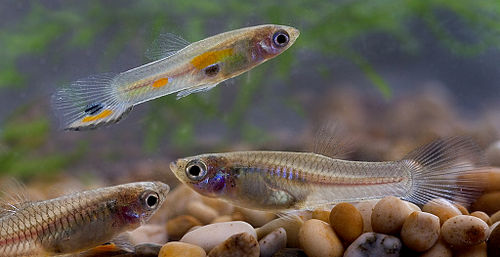
Antoondommerholt at Dutch Wikipedia · CC BY-SA 3.0 — Wikimedia Commons
- Lifespan
- 4-8 years
- Adult size
- 4-5cm
- Min. habitat
- Aquarium 45L+ / 12gal+, planted with calm surface
- Social needs
- Peaceful; fine singly, in pairs or small groups
- Diet
- Omnivore (micro-pellets, flakes, frozen foods)
- Time
- Low
- Cost
- Low
Overview
- The honey gourami is a small, gentle labyrinth fish from the slow waters of India and Bangladesh, turning honey-gold to red when in condition.
- Hardier and far less disease-prone than its dwarf cousin, it is a genuinely good beginner fish.
- Reaching only 4-5cm, it is peaceful, undemanding and well suited to small, calm community tanks.
- Like all gouramis it breathes air at the surface.
- Its easy temperament and resilience make it one of the better entry-level anabantoids available.
Housing
- A planted tank of at least 45L with a calm water surface suits honey gouramis well, kept warm at 22-28C and soft to moderately hard around neutral pH.
- They tolerate a wider range than most gouramis but dislike strong flow.
- Provide floating plants, gentle filtration and cover for their naturally timid nature.
- Keep the water cycled with zero ammonia and nitrite.
- A lid maintains the warm surface air their labyrinth organ needs and stops jumping.
- Their small size makes them well suited to modest aquariums.
Diet
- Honey gouramis are omnivores that readily take quality micro-pellets and flakes as a staple, supplemented with frozen and live foods such as daphnia, brine shrimp and bloodworm.
- In nature they pick tiny invertebrates from plants and the surface.
- Feed small amounts once or twice daily, suited to their tiny mouths.
- A varied diet keeps their honey colour vivid and supports breeding condition.
- They feed mainly in the upper and middle water; avoid overfeeding, as their small appetites are easily satisfied.
Health
- Honey gouramis are notably hardy and, unlike dwarf gouramis, are not strongly associated with the iridovirus problem, making them more reliable.
- Most health issues stem from poor water quality, stress or overcrowding rather than inherited disease.
- Maintain clean, stable, warm water and quarantine new arrivals to keep them thriving.
- Watch for clamped fins, fading colour or loss of appetite as early warning signs.
- With good basic care they routinely live several years, often outlasting flashier but frailer gourami species.
Temperament
- Honey gouramis are among the most peaceful gouramis, shy and unaggressive, and are happy kept singly, as a pair or in a small group, with males far less territorial than dwarf gourami males.
- They do best in a calm, well-planted tank.
- They make good community fish alongside small tetras, rasboras, corydoras and other gentle species, but should not share a tank with fin-nippers or boisterous fish that intimidate them.
- Their timid, easygoing nature suits peaceful nano and community aquariums.
A good fit for
- Beginners wanting an easy labyrinth fish
- Peaceful nano and community tanks
- Keepers seeking a hardy, colourful centrepiece
- Those wanting gourami charm without high disease risk
Common mistakes to avoid
- Strong flow stressing this calm-water fish
- Boisterous or nippy tankmates intimidating them
- No lid, risking chilled labyrinth organ and jumping
- Confusing them with the disease-prone dwarf gourami
Is your enclosure big enough?
Is this urgent?
In a fish tank the patient is usually the water. Test before you treat — dosing a healthy tank for a disease it does not have makes things worse.
Go now
Today
Soon
Never add a new fish to a tank that is not fully cycled, and never treat blind. A test kit is cheaper than the fish.
This is general guidance for a healthy adult, not a diagnosis. An exotics vet who knows your animal always overrides it — and the time to find one is before you need one.
What it really costs
Setup, monthly, first year and across a whole life, itemised and with the electricity worked out from the actual wattage. Published figures for the same animal disagree by a factor of four, so the calculator shows ranges rather than picking one.
More Freshwater Fish guides

Colourful labyrinth fish prone to farmed-stock disease

Lace-patterned, peaceful centrepiece gourami

The thumb-sized gourami you can actually hear

The hobby's first tropical fish, with a temper

Colourful labyrinth fish that lives alone
Colourful livebearer that breeds readily