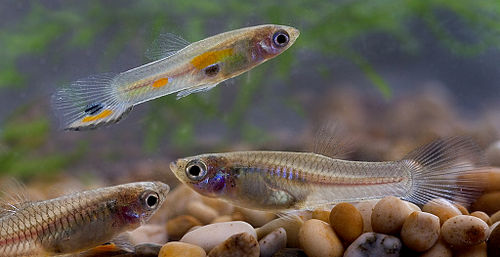
Golden Wonder Killifish
Aplocheilus lineatus
Golden surface hunter with an escape-artist streakBeginner
- Lifespan
- 4-5 years
- Size
- 10cm / 4in
- Social needs
- One male with several females; eats small tankmates
- Time
- 10-15 min daily; weekly water change
- Cost
- Low
- Diet
- Carnivore (insects, larvae, frozen foods, floating pellets)
Overview
What is this animal?
- The Golden Wonder is a selectively bred golden (xanthic) form of the striped panchax, a killifish from the slow streams, ponds, swamps, and rice paddies of India and Sri Lanka.
- At around 10cm (4in) it is one of the largest killifish commonly kept, shaped like a miniature pike with a flattened head and an upturned mouth built for taking prey at the surface.
- Unlike the famous annual killifish, it is a non-annual species that lives roughly four to five years, so it needs no seasonal drying of its eggs or other special breeding tricks to keep going.
- It is hardy, adaptable, and forgiving of a wide range of water conditions, which makes it the easiest entry into killifish keeping.
- Its challenges are behavioural rather than technical: it swallows small tankmates whole and it is a remarkable jumper.
Temperament
- Golden Wonders are peaceful with anything too large to swallow and predatory toward everything else.
- Neon tetras, Endler's livebearers, dwarf shrimp, and fry all register as food, and adding one to a nano community is the classic keeper mistake.
- Sensible tankmates are calm, similarly sized species that use the middle and lower water, such as corydoras, larger rasboras, and peaceful barbs.
- Males are the larger, brighter, more pointed-finned sex and spar with rivals over surface territory, so keep one male with two or more females unless the tank is 100 litres (26 gallons) or more with heavy floating cover.
- Expect long spells of motionless lurking beneath plants broken by sudden dashes at food; this ambush rhythm is normal behaviour, not illness.
A good fit for
- First-time killifish keepers wanting a hardy, long-lived species
- Single-species setups or carefully planned communities
- Keepers who enjoy watching surface-hunting, ambush-predator behaviour
- Covered, planted tanks with calm, similar-sized mid- and lower-water tankmates
Common mistakes to avoid
- Eats any fish or shrimp that fits in its mouth
- Exceptional jumper; one lid gap is usually fatal
- Males spar; keep one male per standard tank
- New arrivals may refuse dry food at first
- Needs floating or slow-sinking food; rarely feeds from the bottom
Enclosure
Minimum 76 litres (20 US gallons)
Fine alone or with company. One male with several females; eats small tankmates
- Provide at least 76 litres (a 20 gallon long) for a trio, and prioritise floor space and surface area over height because these fish live almost entirely in the top few centimetres of water.
- Hold the temperature at 22-25C (72-77F) with a heater, keep the pH between 6.0 and 7.5, and aim for soft to moderately hard water (about 5-19 dGH); they adapt to a wide range without fuss and even tolerate a little added salt.
- A tight, gap-free lid is the single most important piece of equipment, as Golden Wonders are famous escape artists that will find the hole around a filter cable or feeding hatch.
- Floating plants soften the light, give the fish cover to lurk beneath, and noticeably reduce jumping.
- Keep the flow gentle and fully cycle the tank before the fish arrives.
Supplies
Setup
- Tank and stand
- Filter
- Heater and thermometer
- Substrate, plants and decor
- Liquid test kit
- Dechlorinator and starter supplies
Ongoing
- Floating carnivore pellets
- Frozen bloodworm, brine shrimp and daphnia
- Flightless fruit fly culture
- Frozen or live mosquito larvae
- Feeding ring to keep floating food in one place
- Feeding tweezers or pipette
- Fine net for removing leftovers
Safe substrate: Inert aquarium gravel · Fine, smooth sand · Aquasoil for planted tanks
Care routine
Daily
- Check temperature and equipment
- Feed
- Head-count and look everyone over
Weekly
- Top up evaporationevery 3 days
- Check the lid and cable gaps
- Clean glass and clear algae
- Test the water
- Water change and gravel vacuum
Monthly
- Trim and thin the plantsevery 2 weeks
- Check supplies and reagent dates
- Rinse the filter media
Less often
- Replace chemical filter media (Carbon/Purigen)every 2 months
Vet: Quarterly review with a lid check — every 3 months
Top resources for more info
Independent creators and organisations we would send a friend to. We have no affiliation with any of them, and nothing here is sponsored. Links checked 2026-09-19.
YouTubers
Sites
Go deeper
Diet
- Golden Wonders are surface-hunting micropredators that eat insects, insect larvae, and small fish in the wild.
- Frozen and live foods such as bloodworms, brine shrimp, daphnia, mosquito larvae, and flightless fruit flies are taken eagerly from the surface and should form the core of the diet.
- Most individuals learn to accept floating carnivore pellets and flakes, but newly bought fish often refuse dry food for the first week or two.
- Food must float or sink slowly, because they rarely pick anything off the bottom.
- Feed once or twice daily only what is cleared within a couple of minutes, as they will gorge given the chance.
Health
- This is a robust fish, and the most common cause of death is not disease but a leap through an uncovered gap in the lid.
- Make checking the lid part of every feeding and maintenance routine.
- Like most aquarium fish they can develop ich, velvet, or fungal infections after chilling or shipping stress, so quarantine new arrivals for a few weeks and keep the temperature stable.
- Clamped fins, refusal of live food, or hanging low in the tank are warning signs, since a healthy Golden Wonder patrols just under the waterline.
- With clean water and a varied diet they commonly reach four to five years.
Is your enclosure big enough?
Is this urgent?
In a fish tank the patient is usually the water. Test before you treat — dosing a healthy tank for a disease it does not have makes things worse.
Go now
Today
Soon
Never add a new fish to a tank that is not fully cycled, and never treat blind. A test kit is cheaper than the fish.
This is general guidance for a healthy adult, not a diagnosis. An exotics vet who knows your animal always overrides it — and the time to find one is before you need one.
What it really costs
Setup, monthly, first year and across a whole life, itemised and with the electricity worked out from the actual wattage. Published figures for the same animal disagree by a factor of four, so the calculator shows ranges rather than picking one.
Bedding and substrate
Substrate in an aquarium is a filter as much as a floor. Most of the biology lives in and on it.
Safe
With a caveat
Never
This is our general list for freshwater fish. We have not built one specific to Killifish yet.
My kit says 0.25 ppm. Is that dangerous?
A liquid kit measures total ammonia, but only the un-ionised fraction is really toxic, and that fraction is governed by pH and temperature — each whole pH unit multiplies it roughly tenfold. So the same reading can be nearly harmless in one tank and lethal in another; this works out which one you are in.
Compare with other animals
The same axes for every animal, side by side — the way the guides are written makes that a fair comparison rather than two articles.
Other Freshwater Fish worth knowing
Same axes, same care guides — the honest way to compare them.
Browse all Freshwater Fish →