Tailspot Blenny
Ecsenius stigmatura
Charismatic nano algae-grazer with cartoon eyesBeginner
- Lifespan
- 3-5 years
- Size
- 6cm
- Social needs
- One blenny per tank in smaller systems
- Time
- 15-20 min daily; reef-standard upkeep
- Cost
- Low-Medium
- Diet
- Herbivore-leaning (algae, nori, spirulina pellets)
Overview
What is this animal?
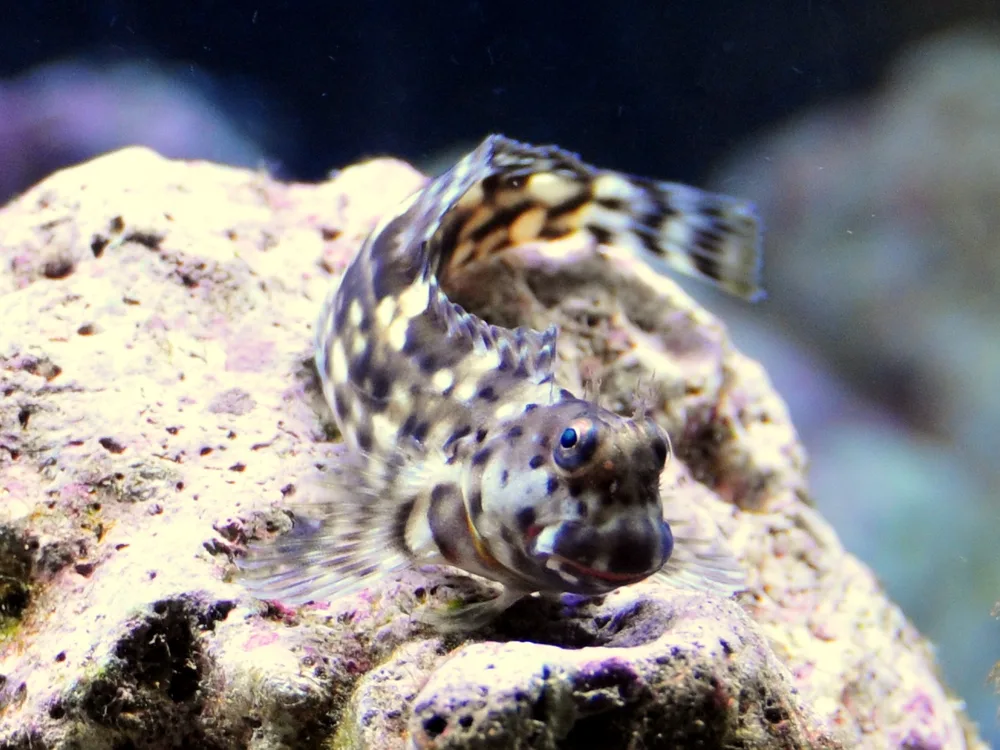
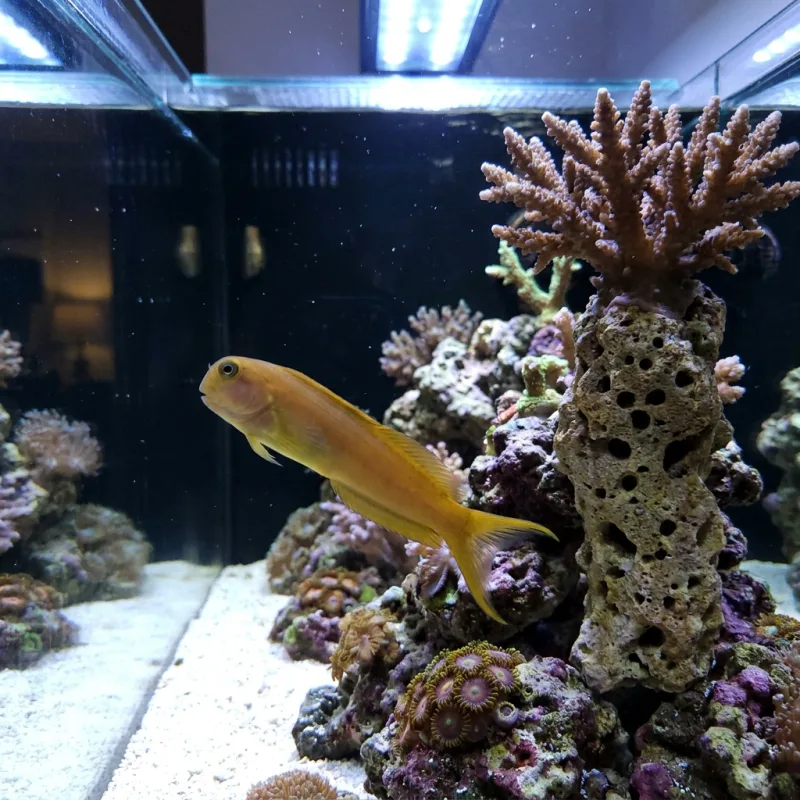
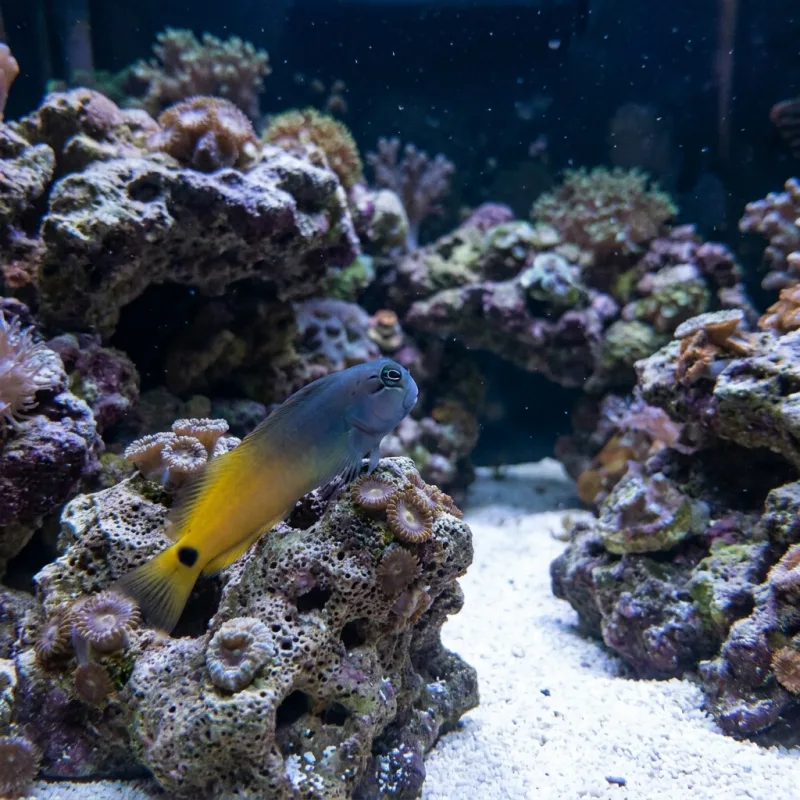
- The tailspot blenny is a small Indo-Pacific grazer with banded eyes, an amber body, and the namesake dark spot at the tail base.
- It spends its day hopping between perches and mowing film algae.
- It is among the best nano-reef fish: small, hardy, useful, and packed with personality for something the size of a finger.
Temperament
- Endlessly watchable: it perches on rockwork with curled tail, swivelling its banded eyes independently at everything that moves, then darts off to graze.
- Many learn to recognise their keeper.
- It is peaceful with everything except close competitors — keep one blenny in smaller tanks, as it may squabble with other algae-grazing blennies over territory.
- It ignores corals, shrimp, and snails entirely.
A good fit for
- Nano and small reef tanks needing personality
- Keepers who want natural algae control
- Peaceful communities of small reef fish
- First-time marine keepers with mature tanks
Common mistakes to avoid
- Brand-new tanks with nothing to graze
- Starvation hiding behind 'it grazes all day'
- Two grazing blennies fighting in small tanks
- Open tops — blennies jump when startled
Enclosure
Minimum 75 litres (20 US gallons)
Must be housed alone. One blenny per tank in smaller systems
- A mature reef of 75 litres (20 gallons) or more with live rock suits it; maturity matters because natural algae and biofilm form the grazing base.
- It claims a small hole or barnacle as home and returns to it constantly.
- Reef-safe and coral-safe, it needs only standard stable parameters — 24-26C, salinity 1.024-1.026 — and, like most blennies, a tight lid.
Supplies
Setup
- Tank, stand and sump
- Return pump and powerheads
- Protein skimmer
- Reef lighting
- Rock and sand
- Salt mix, refractometer and test kits
- Quarantine tank
Ongoing
- Dried marine algae (nori) sheets
- Magnetic or suction veg clip
- Spirulina flake and algae pellets
- Frozen mysis shrimp
- Frozen enriched brine shrimp
- Marine flake or small pellet
- Small thawing cup and strainer
Safe substrate: Aragonite sand · Dry or cured live rock · Bare bottom
Care routine
Daily
- Check salinity, temperature and flow
- Feed
- Head-count and look everyone over
- Top up evaporation with fresh water
Weekly
- Offer nori on a clipevery 2 days
- Service the skimmer and filter socksevery 3 days
- Check the belly profile
- Clean the glass
- Test the water
Monthly
- Water changeevery 2 weeks
- Calibrate the refractometer
- Check salt, RO/DI and reagents
Less often
- Deep-clean pumps and powerheadsevery 3 months
- Replace RO/DI filter mediaevery 6 months
Vet: Quarterly belly-profile review — every 3 months
Top resources for more info
Independent creators and organisations we would send a friend to. We have no affiliation with any of them, and nothing here is sponsored. Links checked 2026-09-19.
YouTubers
Sites
Go deeper
Diet
- Grazing alone rarely sustains one in a clean tank: offer nori on a clip several times a week plus spirulina-rich pellets or flakes.
- It learns feeding routines fast.
- A visibly hollow belly means it is losing the food race — feed more directly.
- Mixed frozen foods are taken too, but vegetable matter should dominate.
Health
- Tailspots are hardy and disease-resistant, with starvation in immature or over-clean tanks the main genuine risk.
- Confirm feeding before purchase if possible.
- Quarantine remains sensible.
- Beyond that, watch only for jumping and for harassment by larger blennies or aggressive grazers competing for the same turf.
Is your enclosure big enough?
Is this urgent?
In a reef, stability matters more than any single target number. A parameter moving fast does more damage than a parameter sitting slightly off.
Go now
Today
Quarantine every new animal, including corals and inverts. It is the single practice that separates a reef that lasts from a reef that restarts.
This is general guidance for a healthy adult, not a diagnosis. An exotics vet who knows your animal always overrides it — and the time to find one is before you need one.
What it really costs
Setup, monthly, first year and across a whole life, itemised and with the electricity worked out from the actual wattage. Published figures for the same animal disagree by a factor of four, so the calculator shows ranges rather than picking one.
Bedding and substrate
In a marine system the rock and the sand are life support, and how you start them decides the first six months.
Safe
With a caveat
Never
This is our general list for saltwater fish. We have not built one specific to Blennies yet.
My kit says 0.25 ppm. Is that dangerous?
A liquid kit measures total ammonia, but only the un-ionised fraction is really toxic, and that fraction is governed by pH and temperature — each whole pH unit multiplies it roughly tenfold. So the same reading can be nearly harmless in one tank and lethal in another; this works out which one you are in.
Compare with other animals
The same axes for every animal, side by side — the way the guides are written makes that a fair comparison rather than two articles.
Blennies, side by side
Same axes, same care guides — the honest way to choose between types.
See all Blennies side by side →