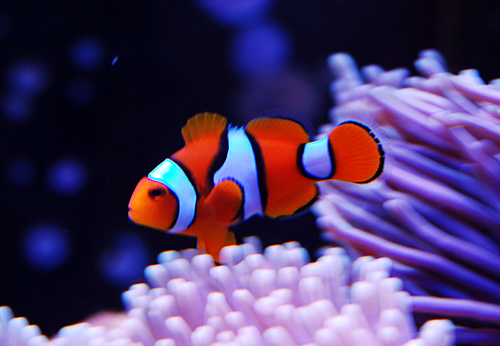
True Percula Clownfish
Amphiprion percula
The "true" clownfish, inked with bold black bordersBeginner
- Lifespan
- 10-20 years (exceptionally long-lived)
- Size
- 6-8 cm (2.5-3 in); female larger
- Social needs
- Single fish or one bonded pair; never unbonded clowns
- Time
- Daily feeding; weekly water testing and changes
- Cost
- Medium (designer morphs cost much more)
- Diet
- Omnivore (marine pellets, frozen mysis/brine, algae)
Overview
What is this animal?
- The True Percula is the near-identical sibling of the Ocellaris and the species scientists call the true clownfish.
- You tell them apart by the Percula's thicker black borders around its white bars, its slightly more saturated orange, its bright orange iris that makes the eye look smaller, and its 10 dorsal-fin spines to the Ocellaris's 11.
- It comes from a smaller wild range than the Ocellaris, centred on Papua New Guinea, the Solomon Islands, and the northern Great Barrier Reef.
- Captive-bred Perculas are widely available, including designer morphs such as Picasso and Platinum, and captive-bred is the only stock worth buying.
- Wild-caught Perculas ship poorly and are notoriously prone to Brooklynella, so a wild fish is a firm not yet for a beginner.
- Between the two look-alikes, the Ocellaris is marginally hardier and cheaper; choose the Percula for its bolder markings and remarkable lifespan, not because it is easier.
Temperament
- Young Perculas are as mild as Ocellaris, but an established pair, and especially the female, defends its chosen patch more sharply, chasing fish and nipping hands that come too close during maintenance.
- This is still nothing like the Maroon's aggression, and it stays confined to a small territory.
- They are reef-safe and ignore corals, though a pair may irritate one specific coral by wallowing in it as an anemone substitute.
- All clownfish are protandrous (male-first) sequential hermaphrodites, and the dominant fish of a pair turns into the larger female; the change is one-way, so a bonded pair is permanent.
- Keep one fish or one bonded pair only, and never mix clownfish species or add a second unbonded clown, because the resident pair will attack it.
- Their bold waggling swim and habit of greeting the keeper at the glass make them one of the most interactive marine fish.
A good fit for
- Reef tanks (reef-safe)
- First or second marine fish, if captive-bred
- Keepers wanting bolder markings than an Ocellaris
- Long-haul keepers ready for a 15-20 year fish
- Modest tanks from 75L (20 gal)
Common mistakes to avoid
- Wild-caught stock - Brooklynella-prone; insist on captive-bred
- Paying Percula prices for a mislabelled Ocellaris
- Buying a demanding anemone the fish does not need
- No lid - clownfish jump
- Adding a second clownfish to an established pair's tank
- Underestimating the multi-decade commitment
Enclosure
Minimum 75 litres (20 US gallons)
Fine alone or with company. Single fish or one bonded pair; never unbonded clowns
- A fully cycled tank of 75L (20 gal) is a sensible minimum for a single fish or a bonded pair — these are small, sedentary clowns that claim one patch of reef and rarely leave it — with live rock for territory and a tight-fitting lid because clownfish jump.
- Maintain salinity 1.024-1.026, temperature 24-27°C (75-80°F), pH 8.1-8.4, ammonia and nitrite at zero, and nitrate below 20 ppm (lower still if you keep corals).
- Stability matters more than perfection, and a little more water volume buffers the swings a small reef is prone to, so invest in a reliable heater, a powerhead for flow, and a proper test kit before the fish.
- No anemone is required, despite the pairing everyone pictures.
- The Percula's natural hosts — the magnificent sea anemone and the giant and Merten's carpet anemones — need intense lighting and a mature tank, and they kill fish in systems that cannot support them.
- In the wild a Percula rarely strays more than a metre from its host, so in captivity the pair will claim one small patch of rock or coral and largely ignore the rest of the tank.
Supplies
Setup
- Tank, stand and sump
- Return pump and powerheads
- Protein skimmer
- Reef lighting
- Rock and sand
- Salt mix, refractometer and test kits
- Quarantine tank
Ongoing
- Quality small marine pellet
- Frozen mysis shrimp
- Frozen enriched brine shrimp
- Algae-based marine flake
- Vitamin or HUFA soaking supplement
- Small thawing cup and strainer
- Turkey baster for target-feeding
Safe substrate: Aragonite sand · Dry or cured live rock · Bare bottom
Care routine
Daily
- Check salinity, temperature and flow
- Feed small marine portions
- Head-count and look everyone over
- Top up evaporation with fresh water
Weekly
- Service the skimmer and filter socksevery 3 days
- Clean the glass
- Test the water
- Watch the pair's pecking order
Monthly
- Water changeevery 2 weeks
- Calibrate the refractometer
- Check salt, RO/DI and reagents
Less often
- Deep-clean pumps and powerheadsevery 3 months
- Replace RO/DI filter mediaevery 6 months
Vet: Quarterly review with a pair check — every 3 months
Top resources for more info
Independent creators and organisations we would send a friend to. We have no affiliation with any of them, and nothing here is sponsored. Links checked 2026-09-19.
YouTubers
Sites
Go deeper
Diet
- Perculas are omnivores that graze on zooplankton and algae in the wild.
- Offer a quality marine pellet or flake as the staple, rotated with frozen mysis, enriched brine shrimp, and an algae-based food such as spirulina flake.
- Feed small amounts once or twice daily, only what the fish clear in a couple of minutes, because uneaten food is the fastest route to high nitrate.
- Captive-bred Perculas take prepared foods from day one, so refusal to eat usually signals stress or disease rather than pickiness.
- Soak frozen foods in a vitamin supplement occasionally to support colour and immune health.
- They are slower, more deliberate feeders than many tankmates, so make sure faster fish are not stripping the water column before the clowns get their share.
Health
- The Percula's defining health risk is Brooklynella, the parasitic clownfish disease that shows as peeling slime, laboured breathing, and rapid decline, and it hits wild-caught Perculas harder than any other clownfish.
- Buying captive-bred stock and quarantining every new arrival for four to six weeks removes most of that risk.
- Marine ich is the other common parasite, showing as white spots and scratching against rock.
- Stable salinity and temperature are the real medicine, because nearly every clownfish disease outbreak follows a stress event such as a swing, a move, or a new aggressive tankmate.
- A well-kept Percula is a genuinely long commitment, with 15 to 20 years realistic and wild fish documented living decades on the same anemone.
- Plan for the fish to outlast most dogs before you buy it.
Is your enclosure big enough?
Is this urgent?
In a reef, stability matters more than any single target number. A parameter moving fast does more damage than a parameter sitting slightly off.
Go now
Today
Quarantine every new animal, including corals and inverts. It is the single practice that separates a reef that lasts from a reef that restarts.
This is general guidance for a healthy adult, not a diagnosis. An exotics vet who knows your animal always overrides it — and the time to find one is before you need one.
What it really costs
Setup, monthly, first year and across a whole life, itemised and with the electricity worked out from the actual wattage. Published figures for the same animal disagree by a factor of four, so the calculator shows ranges rather than picking one.
Bedding and substrate
In a marine system the rock and the sand are life support, and how you start them decides the first six months.
Safe
With a caveat
Never
This is our general list for saltwater fish. We have not built one specific to Clownfish yet.
My kit says 0.25 ppm. Is that dangerous?
A liquid kit measures total ammonia, but only the un-ionised fraction is really toxic, and that fraction is governed by pH and temperature — each whole pH unit multiplies it roughly tenfold. So the same reading can be nearly harmless in one tank and lethal in another; this works out which one you are in.
Compare with other animals
The same axes for every animal, side by side — the way the guides are written makes that a fair comparison rather than two articles.
Clownfish, side by side
Same axes, same care guides — the honest way to choose between types.
See all Clownfish side by side →


