Maroon Clownfish
Amphiprion biaculeatus
Large, boldly coloured and notably aggressive clownfish · Intermediate

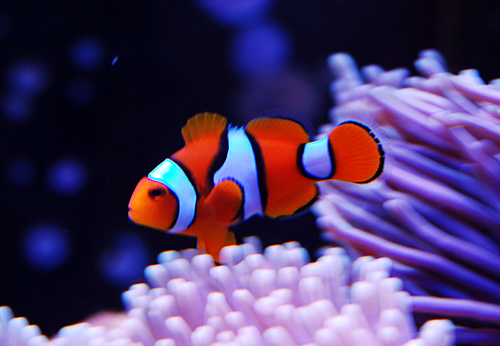
Bernard DUPONT from FRANCE · CC BY-SA 2.0 — Wikimedia Commons
- Lifespan
- 10-15 years
- Adult size
- 15-17 cm (6-7 in) female
- Min. habitat
- Aquarium 210L+ / 55gal+
- Social needs
- Solitary or one bonded pair only
- Diet
- Omnivore (meaty frozen, pellets, algae)
- Time
- Daily feeding; weekly testing/changes
- Cost
- Medium
Overview
- The Maroon is the largest and most aggressive clownfish, with deep maroon-red colour and white or gold stripes.
- The female grows much larger than the male and dominates the pair.
- It is hardy and long-lived, but its temperament makes it unsuitable for peaceful community tanks.
- Note that the former genus Premnas was merged into Amphiprion in 2021, so older sources list it as Premnas biaculeatus.
- With this clownfish, size and attitude matter.
- A large female harasses tankmates, nips hands during maintenance, and bullies smaller fish.
- Choose it for its appearance only if you can give it space and select tankmates carefully.
Housing
- Provide at least 210L (55 gal) for the adult size and territorial range, with robust live rock structure.
- Keep salinity 1.024-1.026, temperature 24-27°C (75-80°F), pH 8.1-8.4, and nitrate below 20 ppm in a fully cycled system.
- A secure lid prevents jumping.
- Introduce a true bonded pair while young, or keep a single fish, since unbonded adults fight viciously.
- Add the Maroon last so it cannot claim the whole tank before tankmates settle.
- Strong, stable conditions keep this large clownfish healthy long-term.
Diet
- Maroons are hearty omnivores.
- Feed a marine pellet staple plus meaty frozen foods such as mysis and chopped seafood, with some algae-based food for balance.
- Adults have big appetites, so feed once or twice daily without overfeeding the tank.
- They accept prepared foods readily, especially captive-bred specimens.
- A varied diet supports their colour and immune strength.
- Soak frozen foods in vitamins occasionally and do not let uneaten food foul the water.
Health
- Like all clownfish they are prone to marine ich and Brooklynella when stressed, but their hardiness makes serious illness uncommon in stable water.
- Quarantine new fish and keep salinity and temperature steady to avoid outbreaks.
- Watch for scratching, white spots, or laboured breathing.
- Their aggression can also injure tankmates, so monitor other fish for fin damage rather than the robust Maroon itself.
- Good husbandry keeps them healthy for well over a decade.
Temperament
- The Maroon is the most belligerent clownfish, with females in particular defending a large territory and bullying tankmates and even the aquarist's hand.
- It is reef-safe with corals but a threat to small, peaceful fish.
- Keep a single fish or one young bonded pair only; never mix it with other clownfish species.
- Because of its size and aggression it suits a larger, carefully stocked tank where calmer or similarly bold tankmates can hold their own.
A good fit for
- Keepers wanting a large, bold clownfish
- Larger reef or FOWLR tanks
- Aquarists who can manage aggression
- Single-specimen or bonded-pair setups
Common mistakes to avoid
- Underestimating adult size and aggression
- Mixing with other clownfish species
- Keeping two unbonded adults together
- Too-small tank causing constant bullying
Is your enclosure big enough?
Is this urgent?
In a reef, stability matters more than any single target number. A parameter moving fast does more damage than a parameter sitting slightly off.
Go now
Today
Quarantine every new animal, including corals and inverts. It is the single practice that separates a reef that lasts from a reef that restarts.
This is general guidance for a healthy adult, not a diagnosis. An exotics vet who knows your animal always overrides it — and the time to find one is before you need one.
What it really costs
Setup, monthly, first year and across a whole life, itemised and with the electricity worked out from the actual wattage. Published figures for the same animal disagree by a factor of four, so the calculator shows ranges rather than picking one.
More Saltwater Fish guides

Hardy, beginner-friendly reef-tank clownfish
The "true" clownfish, inked with bold black borders

The hardy yellowtail that hosts in anything

Striped cardinalfish best bought captive-bred

Yellow algae-grazer needing serious swimming space

Hardy, colourful dwarf angel for reef tanks