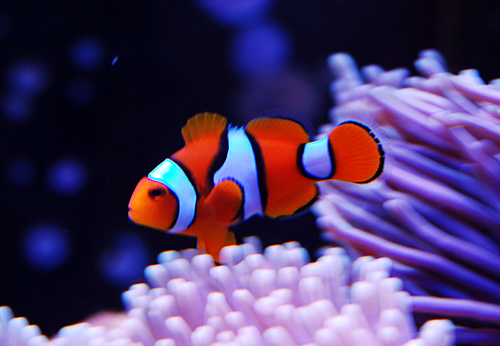
Clarkii Clownfish
Amphiprion clarkii
The hardy yellowtail that hosts in anythingIntermediate
- Lifespan
- 10-15 years, sometimes longer
- Size
- 10-15 cm (4-6 in); female notably larger
- Social needs
- Solitary or one bonded pair only
- Time
- Daily feeding; weekly testing and water changes
- Cost
- Medium
- Diet
- Omnivore (marine pellets, meaty frozen, algae)
Overview
What is this animal?
- The Clarkii, or Clark's anemonefish, is the hardy middleweight of the clownfish family, with a dark brown-to-black body, two broad white bars, and bright yellow fins and tail.
- It has the widest natural range of any clownfish, from the Persian Gulf across the Indo-Pacific to southern Japan, and that adaptability shows in the aquarium.
- Females grow noticeably larger than males and can reach about 15 cm (6 in), a full size class above the Ocellaris.
- Its defining trait is anemone partnership: the Clarkii is the only clownfish recorded hosting in all ten natural host anemone species, so it is the species most likely to actually use an anemone in captivity.
- It does not need an anemone to thrive, and anemones themselves are demanding animals best left to experienced keepers with a mature system.
- Colours often darken with age, and captive-bred stock is widely available and worth insisting on.
- Choose a Clarkii as a step up from the beginner clownfish, at least as hardy as an Ocellaris but larger, more active, and more territorial.
- It is still a decade-plus commitment in a fully equipped marine system.
Temperament
- The Clarkii sits between the other clownfish in temperament, bolder and pushier than an Ocellaris but well short of a Maroon's outright aggression.
- Juveniles are peaceful, while a mature female becomes territorial, chases fish that stray into her patch, and may nip the hand that reaches in during maintenance.
- Like all clownfish they start life male, and the dominant fish of a pair changes sex to become the larger female.
- Keep one fish or one bonded pair, and never mix clownfish species in a single tank.
- They are reef-safe with corals, though a fish without an anemone may pester a coral by adopting it as a substitute host.
- Choose tankmates that can hold their own around a confident, fast-moving fish.
A good fit for
- Keepers stepping up from their first marine or reef setup
- Reef tanks that may add a hardy host anemone later
- Aquarists wanting the hardiest, most forgiving clownfish
- Tanks with open swimming room for an active, open-water fish
- Single-specimen or one bonded male-female pair setups
- Buyers who insist on captive-bred stock
Common mistakes to avoid
- Buying a host anemone before the tank is mature enough to keep one alive
- Mixing Clarkii with other clownfish species in one tank
- Underestimating a mature female's territorial temper at maintenance time
- An Ocellaris-sized tank for this larger, faster, more active fish
- No tight lid - clownfish are determined jumpers
- Skipping quarantine, which invites Brooklynella, velvet, and marine ich
Enclosure
Minimum 150 litres (40 US gallons)
Fine alone or with company. Solitary or one bonded pair only
- A bonded pair needs a cycled marine tank of at least 150 L (40 gal), and more is better, because this is a larger, faster swimmer than the Ocellaris that patrols open water rather than hugging one spot.
- The old 30 gal (115 L) figure is a bare minimum for a single fish; give a pair the extra length and swimming room.
- Provide live rock for territory and cover, plenty of open water, and a tight-fitting lid, since clownfish are determined jumpers.
- Maintain salinity 1.024-1.026, temperature 24-27°C (75-80°F), pH 8.1-8.4, ammonia and nitrite at zero, and nitrate below 20 ppm.
- Add fish only to a fully cycled system that has finished processing ammonia and nitrite.
- If you want the classic clownfish-in-anemone picture, a hardy bubble-tip anemone (Entacmaea quadricolor) is the usual partner, but it demands strong reef lighting, stable water chemistry, and a tank matured for six months or more.
- Treat the anemone as a separate advanced project, not a Clarkii accessory.
Supplies
Setup
- Tank, stand and sump
- Return pump and powerheads
- Protein skimmer
- Reef lighting
- Rock and sand
- Salt mix, refractometer and test kits
- Quarantine tank
Ongoing
- Quality small marine pellet
- Frozen mysis shrimp
- Frozen enriched brine shrimp
- Algae-based marine flake
- Vitamin or HUFA soaking supplement
- Small thawing cup and strainer
- Turkey baster for target-feeding
Safe substrate: Aragonite sand · Dry or cured live rock · Bare bottom
Care routine
Daily
- Check salinity, temperature and flow
- Feed small marine portions
- Head-count and look everyone over
- Top up evaporation with fresh water
Weekly
- Service the skimmer and filter socksevery 3 days
- Clean the glass
- Test the water
- Watch the pair's pecking order
Monthly
- Water changeevery 2 weeks
- Calibrate the refractometer
- Check salt, RO/DI and reagents
Less often
- Deep-clean pumps and powerheadsevery 3 months
- Replace RO/DI filter mediaevery 6 months
Vet: Quarterly review with a pair check — every 3 months
Top resources for more info
Independent creators and organisations we would send a friend to. We have no affiliation with any of them, and nothing here is sponsored. Links checked 2026-09-19.
YouTubers
Sites
Go deeper
Diet
- Clarkii are unfussy omnivores with big appetites for their size.
- Feed a quality marine pellet as the staple, plus frozen mysis, brine shrimp, and finely chopped seafood, with algae- or spirulina-based food for balance.
- Offer small amounts once or twice daily, only what is eaten within a couple of minutes.
- They feed boldly and can outcompete shy tankmates, so make sure slower fish actually get their share.
- Captive-bred fish usually take prepared foods immediately.
- Vary the diet to keep colour strong, and remember that overfeeding is the fastest way to wreck marine water quality.
Health
- The Clarkii is arguably the toughest clownfish, but it shares the family's weaknesses: marine ich (Cryptocaryon), the fast-moving clownfish disease Brooklynella, and the even deadlier marine velvet (Amyloodinium).
- All three usually follow stress, poor water quality, or skipped quarantine.
- Quarantine every new arrival for several weeks in a separate tank before it joins the display.
- Watch for white spots, a greasy or peeling skin coat, scratching against rock, clamped fins, or rapid breathing, and act the day you see them.
- Stable salinity and temperature prevent most problems in this robust species.
- A healthy captive-bred Clarkii routinely lives 10-15 years, and sometimes longer, so plan for the commitment, not just the purchase.
Is your enclosure big enough?
Is this urgent?
In a reef, stability matters more than any single target number. A parameter moving fast does more damage than a parameter sitting slightly off.
Go now
Today
Quarantine every new animal, including corals and inverts. It is the single practice that separates a reef that lasts from a reef that restarts.
This is general guidance for a healthy adult, not a diagnosis. An exotics vet who knows your animal always overrides it — and the time to find one is before you need one.
What it really costs
Setup, monthly, first year and across a whole life, itemised and with the electricity worked out from the actual wattage. Published figures for the same animal disagree by a factor of four, so the calculator shows ranges rather than picking one.
Bedding and substrate
In a marine system the rock and the sand are life support, and how you start them decides the first six months.
Safe
With a caveat
Never
This is our general list for saltwater fish. We have not built one specific to Clownfish yet.
My kit says 0.25 ppm. Is that dangerous?
A liquid kit measures total ammonia, but only the un-ionised fraction is really toxic, and that fraction is governed by pH and temperature — each whole pH unit multiplies it roughly tenfold. So the same reading can be nearly harmless in one tank and lethal in another; this works out which one you are in.
Compare with other animals
The same axes for every animal, side by side — the way the guides are written makes that a fair comparison rather than two articles.
Clownfish, side by side
Same axes, same care guides — the honest way to choose between types.
See all Clownfish side by side →