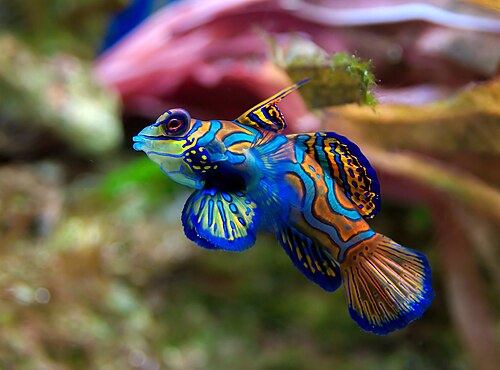
Mandarin Dragonet
Synchiropus splendidus
Strikingly coloured fish needing a copepod-rich tank · Advanced
- Lifespan
- 5-10 years
- Adult size
- 6-8cm (2.5-3in)
- Min. habitat
- Mature reef 200L+ / 55gal+ with refugium
- Social needs
- One male per tank; a female may be added
- Diet
- Carnivore, live copepods primarily
- Time
- High
- Cost
- High
Overview
- The Mandarin Dragonet is a strikingly coloured fish, swirled in green, orange, and blue.
- Despite its calm, slow-moving charm, it is an advanced fish because of its specialised diet of small live invertebrates, mainly copepods.
- Most mandarins die slowly of starvation in tanks that cannot sustain a copepod population.
- Success needs a large, mature reef, ideally with a refugium, and patience to establish a thriving food supply.
Housing
- Provide a well-established reef of at least 200L (55 gallons), and realistically larger, with abundant live rock and a sandbed that hosts copepods.
- A refugium or pod-culturing system is strongly recommended to replenish the food supply.
- Keep temperature 24-27C (75-81F), salinity 1.024-1.026, pH 8.1-8.4, and ammonia and nitrite at zero.
- The tank must be biologically mature, never new, before a mandarin is introduced.
Diet
- A specialised carnivore that grazes copepods and amphipods picked from rock and sand throughout the day.
- A single fish can quickly exhaust a tank's pod population, so a refugium and regular pod top-ups are important.
- Many individuals never accept prepared food, though some can be trained onto frozen cyclops, baby brine, or pellets, and captive-bred mandarins take prepared diets more readily.
- Choose feeding specimens whenever possible.
Health
- When properly fed, mandarins are reasonably hardy and resistant to ich thanks to a thick protective slime coat.
- The main health risk is slow starvation, visible as a pinched belly and hollow stomach over weeks.
- Quarantine and stable water remain important, but the single best safeguard is confirming the fish eats and maintaining a robust food supply.
- A plump, rounded belly indicates a thriving mandarin.
Temperament
- Peaceful, slow, and shy, it spends the day methodically hopping across rock and sand hunting pods.
- It is reef-safe and harmless to corals and invertebrates, making a calm community fish.
- Males are territorial toward other males, so keep only one male per tank; a male and female can coexist in a large system.
- Avoid fast, greedy tankmates that outcompete it for food.
A good fit for
- Experienced keepers with mature reefs
- Tanks with a refugium and pod culture
- Aquarists who choose captive-bred, feeding stock
- Patient hobbyists with peaceful communities
Common mistakes to avoid
- Starves without an established copepod supply
- Sold for immature tanks that cannot feed it
- Watch for a pinched, hollow belly
- Greedy tankmates outcompete this slow feeder
Is your enclosure big enough?
Is this urgent?
In a reef, stability matters more than any single target number. A parameter moving fast does more damage than a parameter sitting slightly off.
Go now
Today
Quarantine every new animal, including corals and inverts. It is the single practice that separates a reef that lasts from a reef that restarts.
This is general guidance for a healthy adult, not a diagnosis. An exotics vet who knows your animal always overrides it — and the time to find one is before you need one.
What it really costs
Setup, monthly, first year and across a whole life, itemised and with the electricity worked out from the actual wattage. Published figures for the same animal disagree by a factor of four, so the calculator shows ranges rather than picking one.
More Saltwater Fish guides

Large, active reef fish needing serious swimming space

Hardy, beginner-friendly reef-tank clownfish

Large, boldly coloured and notably aggressive clownfish

Purple-and-gold peaceful reef basslet

Slender dartfish with a flicking dorsal flag

Sand-sifting goby that shares a pistol-shrimp burrow