Mourning Gecko
Lepidodactylus lugubris
Tiny, chatty, all-female gecko that lives in groupsBeginner
- Lifespan
- 8-12 years
- Size
- 8-10cm including tail
- Social needs
- Unusually social; small all-female groups thrive
- Time
- Low-Medium (daily misting, feeds)
- Cost
- Low-Medium
- Diet
- Fruit-gecko diet powder + tiny insects
Overview
What is this animal?
- The mourning gecko is a tiny tropical gecko with a remarkable trait: the species is parthenogenetic, so virtually all individuals are females that lay viable eggs without a male.
- Every animal in the hobby is effectively part of one extended clone line.
- Unlike almost every other pet reptile, mourning geckos genuinely do well in small groups, squeaking and chirping to each other after dark.
- Their size, hardiness, and social behaviour make them a superb first arboreal gecko — as long as escape-proofing is taken seriously.
Temperament
- These are watch-and-listen pets, active mostly after dark and far too small and fast for handling.
- The trade-off is genuinely engaging group behaviour: chirping, tail-waving, and squabbles over the best feeding ledge.
- A pecking order is normal in groups; provide multiple feeding stations and visual barriers so lower-ranked animals eat and rest in peace.
A good fit for
- First-time gecko keepers wanting something hands-off
- Fans of planted, bioactive display terrariums
- Keepers who want rare-for-reptiles social behaviour
- Small spaces: a nano terrarium houses a group
Common mistakes to avoid
- Escapes: hatchlings fit through ventilation gaps
- Letting the enclosure dry out for days
- Unplanned population growth from constant eggs
- Expecting a handleable pet — they are display animals
Enclosure
Minimum 900 cm² of floor (140 sq in) — for a group of 3 · 30 × 30 × 45 cm
Cannot be kept alone. The minimum is 3, and the space above is for that group.
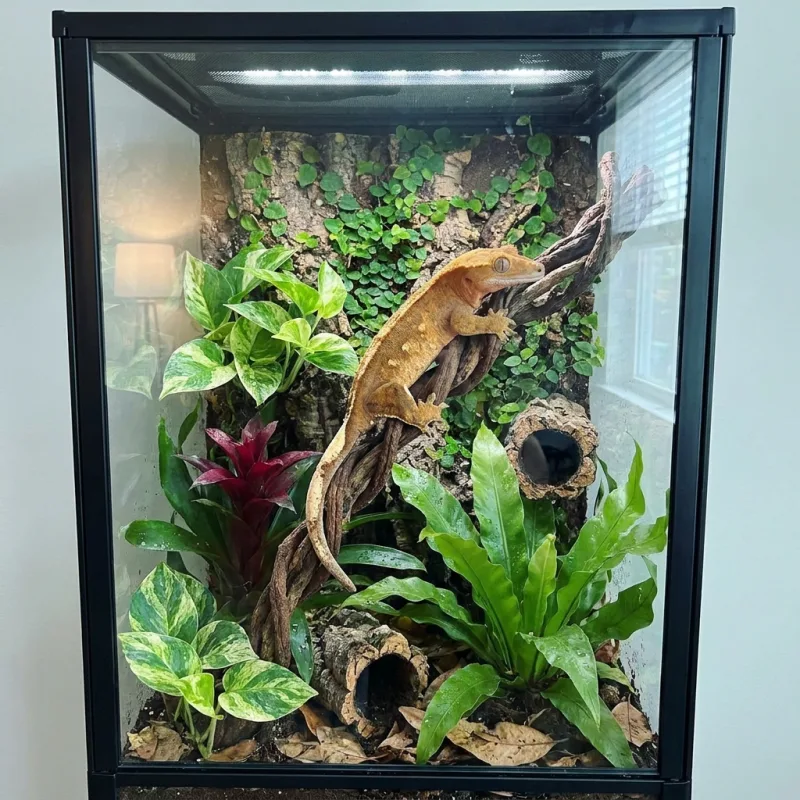
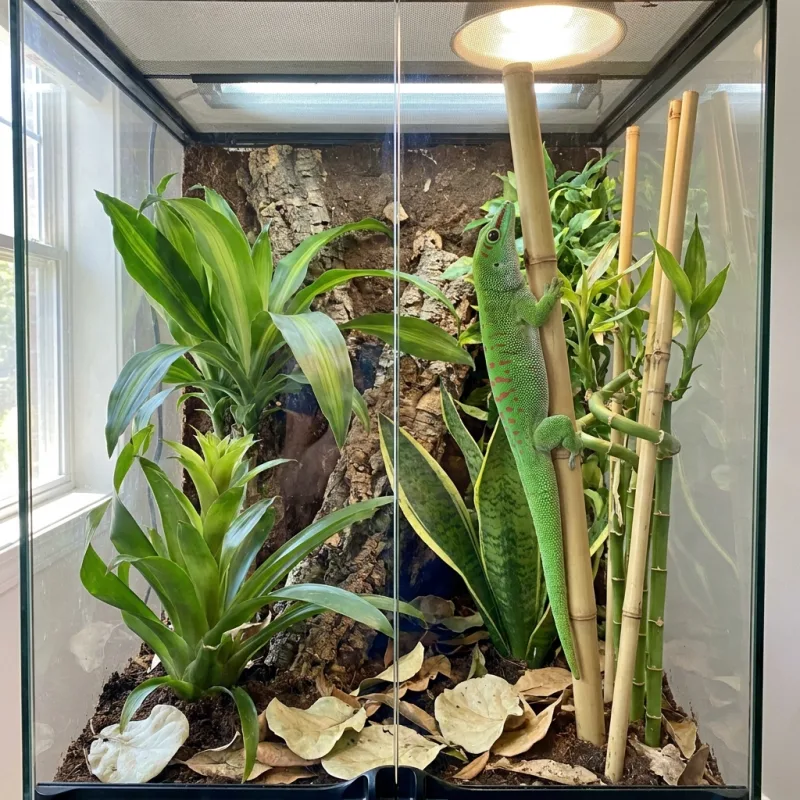
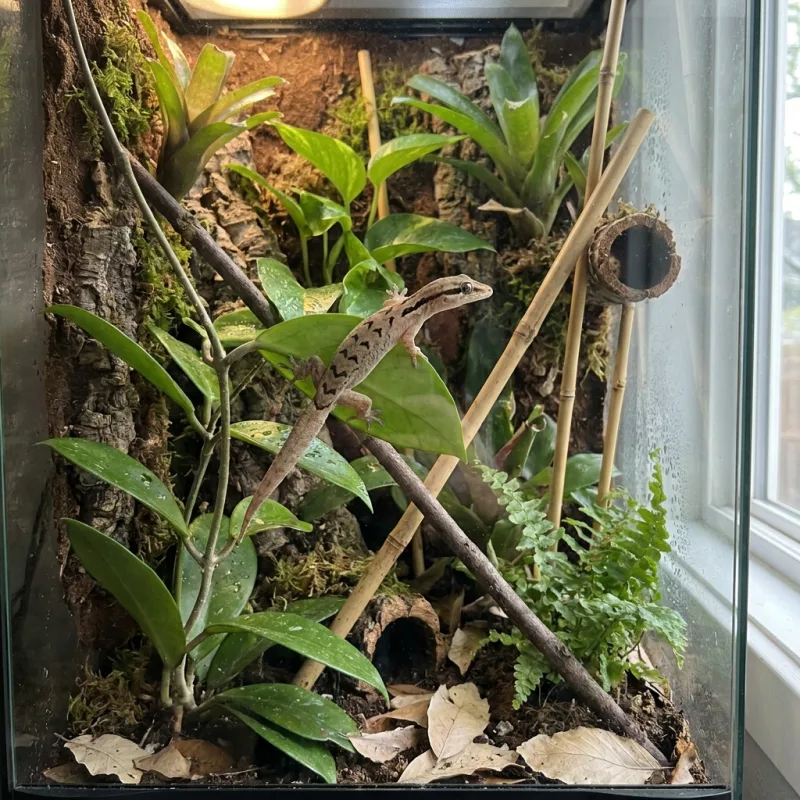
- A planted, vertically oriented terrarium of at least 30×30×45cm suits a group of two to four; bigger is better and live plants double as cover and humidity buffers.
- Cork bark, bamboo, and broad leaves give climbing routes and egg-laying sites.
- Keep the enclosure at 24-28C with a mild ambient drop at night and humidity around 60-80%, misting daily.
- These geckos are tiny and quick, so every gap, wire pass-through, and door seam must be escape-proofed.
Supplies
Setup
- Enclosure
- Heating and thermostat
- Low-output UVB fixture and bulb
- Thermometers and hygrometer
- Substrate, hides including a humid hide, decor
Ongoing
- Complete powdered fruit-gecko diet (for cresteds, gargoyles, chahouas, mourning geckos)
- Live crickets, dubia roaches or black soldier fly larvae
- Plain calcium powder without D3
- Calcium with D3 plus a reptile multivitamin
- Feeder gut-load and a ventilated feeder tub
- Shallow ledge-mounted feeding cups
- Blunt-tipped feeding tongs
- Shallow water dish
Safe substrate: Topsoil and play sand mix for arid geckos · Coco fibre and orchid bark for tropical geckos · Paper towel
Care routine
Daily
- Check temperatures and humidity
- Fresh water bowl
- Look the animal over
- Mist the enclosure
- Spot-clean waste and uneaten food
Weekly
- Feed insects or prepared dietevery 2 days
- Check toes, tail tip and eyes after a shedevery 3 days
- Short handling session, species permittingevery 3 days
- Re-damp the humid hide
Monthly
- Weigh-inevery 2 weeks
- Deep-clean the enclosure
- Test thermostats, lamps and guards
Less often
- Refresh the substrateevery 3 months
- Replace the UVB lampevery 6 months
Vet: Annual exam and faecal check — every 12 months (every 6 months from 10 years old)
Top resources for more info
Independent creators and organisations we would send a friend to. We have no affiliation with any of them, and nothing here is sponsored. Links checked 2026-09-19.
YouTubers
Sites
Go deeper
Diet
- A commercial fruit-gecko meal-replacement powder (the same products used for crested geckos) can form the staple, offered fresh two to three times a week in small cups.
- It covers vitamins and calcium when prepared correctly.
- Supplement with tiny live insects such as fruit flies, bean beetles, or pinhead crickets once or twice a week, dusted with calcium.
- Remove uneaten wet food before it sours in the humid enclosure.
Health
- Mourning geckos are hardy when humidity and temperature are right; problems usually trace back to dehydration, stuck sheds on toes, or calcium deficiency in heavily laying females.
- A fine misting routine and dusted insects prevent most of it.
- Expect eggs: females glue pairs of eggs to glass and plants year-round, and hatchlings are mosquito-sized escape artists.
- Plan for population growth or remove eggs, and rehome surplus responsibly.
Is your enclosure big enough?
Is this urgent?
Small geckos dehydrate and lose condition quickly, and the tail is the fuel gauge.
Go now
Today
This is general guidance for a healthy adult, not a diagnosis. An exotics vet who knows your animal always overrides it — and the time to find one is before you need one.
Can a mourning gecko eat that?
Geckos split into two diets that share almost nothing: insectivores like the leopard gecko, and the fruit-and-insect species like the crested gecko. Check which one you have.
The full list
Never (13)
Rare treats (1)
Occasional (4)
Everyday foods (4)
That food is not on our list. Check which kind of gecko you have first — the two diets barely overlap — then ask an exotics vet.
Dust feeders with calcium to the schedule in the species guide, and keep a small dish of plain calcium available for insectivorous species.
What it really costs
Setup, monthly, first year and across a whole life, itemised and with the electricity worked out from the actual wattage. Published figures for the same animal disagree by a factor of four, so the calculator shows ranges rather than picking one.
Bedding and substrate
Match the substrate to the species' humidity, and never let a small gecko stand on anything it can swallow whole.
Safe
With a caveat
Never
A humid hide is not optional for most geckos, whatever the main substrate is. Most stuck-shed problems trace back to its absence.
Compare with other animals
The same axes for every animal, side by side — the way the guides are written makes that a fair comparison rather than two articles.
Geckos, side by side
Same axes, same care guides — the honest way to choose between types.
See all Geckos side by side →