Molly
Poecilia sphenops
Sociable livebearer that prefers hard water · Intermediate

(c) James-LaFontaine, some rights reserved (CC BY) · CC BY 4.0 — Wikimedia Commons
- Lifespan
- 3-5 years
- Adult size
- 6-12cm / 2.5-4.5in
- Min. habitat
- Aquarium 113L+ / 30gal+, heated and filtered
- Social needs
- Social; keep in groups
- Diet
- Omnivore, algae-heavy (flake, veg, pellet)
- Time
- 15 min daily; weekly water change
- Cost
- Medium
Overview
- Mollies are robust, sociable livebearers from Central America, available in shortfin, sailfin, and balloon forms and colours from black to dalmatian.
- They are larger and more demanding than other common livebearers, so they suit a keeper ready to step up.
- They prefer hard, alkaline, mineral-rich water, and many populations tolerate or benefit from slightly brackish conditions.
- Poor water chemistry, not poor hardiness, is the usual reason mollies fail in beginner tanks.
Housing
- Because they grow large and produce a lot of waste, mollies need at least 113 litres (30 gallons), more for sailfins, with strong filtration.
- Keep the temperature at 24-28C (75-82F) in hard, alkaline water; adding aquarium salt or a marine mineral mix suits many strains.
- Provide open swimming length, planting, and algae-friendly surfaces.
- Stable, well-buffered water is essential, as mollies are sensitive to ammonia and pH swings.
- A tight lid contains them, and a mature, well-cycled filter is non-negotiable.
Diet
- Mollies are omnivores with a strong herbivorous bias and need plenty of plant matter.
- Offer a spirulina or vegetable flake base, blanched greens, and algae, supplemented with occasional frozen or live foods such as daphnia and bloodworms.
- They graze constantly on biofilm and algae, so a mature tank helps.
- Feed small portions two or three times daily and ensure adequate fibre, as a protein-heavy, low-veg diet commonly causes constipation, bloating, and digestive problems in balloon forms.
Health
- Mollies are prone to the so-called molly disease or shimmies, a quivering, near-stationary swimming that signals poor water quality, soft water, or mineral deficiency rather than a single pathogen.
- Correcting to hard, stable, well-buffered parameters usually resolves it.
- They also suffer ich, fungal, and bacterial infections after chilling or stress.
- Balloon mollies in particular have deformed spines and compressed organs, predisposing them to swim-bladder and digestive problems, an ethical reason many keepers avoid that form.
Temperament
- Mollies are generally peaceful and social, best kept in groups and content in a calm community of similarly sized fish.
- Males can be persistent in courtship, so a female-biased ratio and adequate space reduce harassment.
- Larger males may occasionally show mild territoriality but rarely cause harm in a spacious tank.
- They are prolific livebearers; mixed groups breed continuously, and adults eat fry unless dense planting or a breeding setup gives the young cover.
A good fit for
- Keepers ready for a larger livebearer
- Hard-water and lightly brackish setups
- Algae-rich planted community tanks
- Aquarists who can maintain stable parameters
Common mistakes to avoid
- Keeping in soft or unstable water causing shimmies
- Undersized tanks for their size and waste load
- Protein-heavy, low-vegetable diets
- Buying deformed balloon forms with health issues
Is your enclosure big enough?
Is this urgent?
In a fish tank the patient is usually the water. Test before you treat — dosing a healthy tank for a disease it does not have makes things worse.
Go now
Today
Soon
Never add a new fish to a tank that is not fully cycled, and never treat blind. A test kit is cheaper than the fish.
This is general guidance for a healthy adult, not a diagnosis. An exotics vet who knows your animal always overrides it — and the time to find one is before you need one.
What it really costs
Setup, monthly, first year and across a whole life, itemised and with the electricity worked out from the actual wattage. Published figures for the same animal disagree by a factor of four, so the calculator shows ranges rather than picking one.
More Freshwater Fish guides
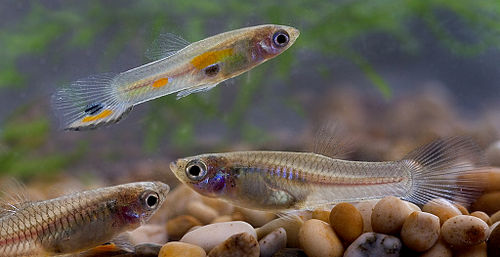
Colourful livebearer that breeds readily

Tiny, colourful livebearer for nano tanks

Hardy, colourful community livebearer

Active livebearer with a bladed tail

Schooling characin for mature, planted tanks

Blue-and-red shoaler from soft blackwater