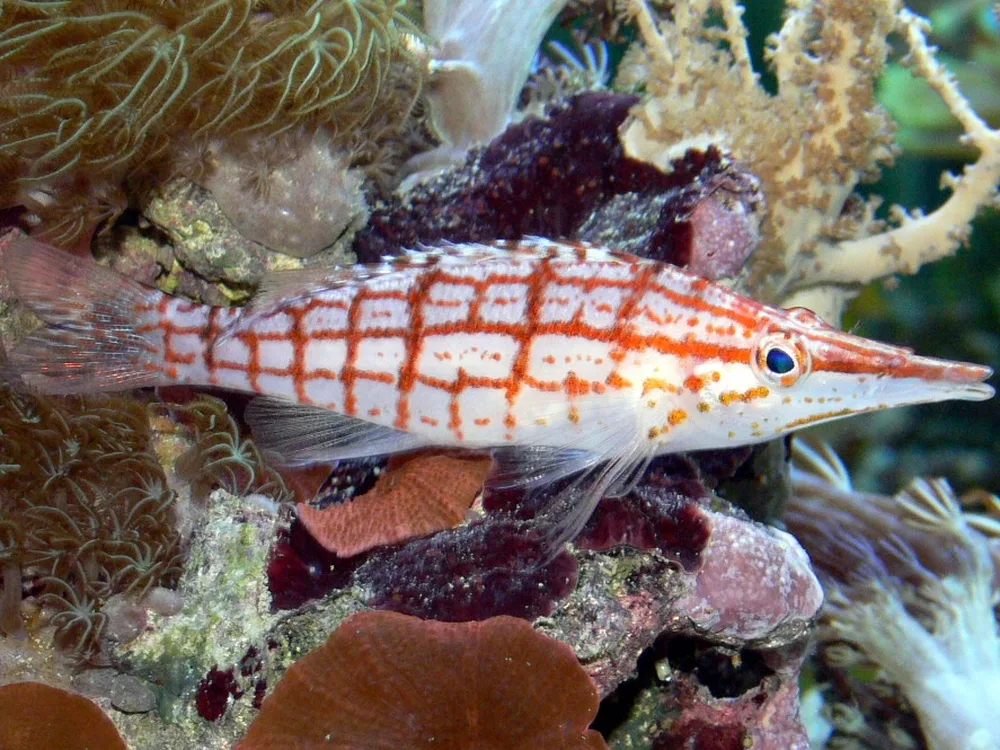
Longnose Hawkfish
Oxycirrhites typus
Checkered perch-hunter that surveys the reefIntermediate
- Lifespan
- 5-7 years
- Size
- 10-13cm
- Social needs
- One hawkfish per tank
- Time
- 15-20 min daily; reef-standard upkeep
- Cost
- Medium-High
- Diet
- Carnivore (frozen mysis, krill, chopped seafood)
Overview
What is this animal?
- The longnose hawkfish wears a red-on-white crosshatch and a needle snout, and lives like its namesake: perched high on the reef, watching, then striking.
- In the wild it sits in gorgonians and black corals at depth.
- It is hardy, disease-resistant, and full of character — one of the most rewarding 'personality fish' in the hobby, with stocking caveats that need respecting.
Temperament
- It is peaceful with fish too large to swallow but a genuine predator of small, slender fish and ornamental shrimp: firefish, small gobies, and cleaner shrimp are at real risk.
- Stock around its mouth, not its manners.
- Keep one hawkfish per tank; two will fight for the high perch.
- With suitable tankmates it is bold, watchful, and quickly learns to anticipate feeding — often hopping perch to perch to track its keeper across the room.
A good fit for
- Keepers who want an interactive character fish
- Reefs with tall rockwork and branching decor
- Communities of mid-sized, robust fish
- Aquarists tired of delicate marine species
Common mistakes to avoid
- Ornamental shrimp — they will be eaten
- Tiny slender fish disappearing one by one
- Open lids: hawkfish jump far and fast
- Pairing two hawkfish over one prime perch
Enclosure
Minimum 150 litres (40 US gallons)
Must be housed alone. One hawkfish per tank
- Provide 150 litres (40 gallons) or more with tall rockwork, branching structures, or gorgonian-like decor for perching; a hawkfish without lookout posts is a stressed hawkfish.
- It rests on its pectoral fins rather than swimming constantly.
- It is coral-safe and fine in reefs at standard parameters: 24-26C, salinity 1.024-1.026.
- The lid must be tight — hawkfish are explosive jumpers when startled.
Supplies
Setup
- Tank, stand and sump
- Return pump and powerheads
- Protein skimmer
- Reef lighting
- Rock and sand
- Salt mix, refractometer and test kits
- Quarantine tank
Ongoing
- Frozen mysis shrimp
- Frozen krill
- Frozen enriched brine shrimp
- Frozen chopped seafood blend
- Marine carnivore pellets
- Feeding tongs
- Small thawing cup and strainer
Safe substrate: Aragonite sand · Dry or cured live rock · Bare bottom
Care routine
Daily
- Check salinity, temperature and flow
- Check the lid
- Feed
- Head-count and look everyone over
- Top up evaporation with fresh water
Weekly
- Service the skimmer and filter socksevery 3 days
- Clean the glass
- Test the water
Monthly
- Water changeevery 2 weeks
- Calibrate the refractometer
- Check salt, RO/DI and reagents
Less often
- Deep-clean pumps and powerheadsevery 3 months
- Replace RO/DI filter mediaevery 6 months
Vet: Quarterly review with a lid check — every 3 months
Top resources for more info
Independent creators and organisations we would send a friend to. We have no affiliation with any of them, and nothing here is sponsored. Links checked 2026-09-19.
YouTubers
Sites
Go deeper
Diet
- Feed meaty foods once or twice daily: frozen mysis, krill, enriched brine, and chopped seafood, with marine carnivore pellets accepted in time.
- The strike from a perch is fast and accurate.
- Vary the menu; a hawkfish on one food sulks and fades.
- They are unfussy eaters once settled, usually within days.
Health
- Longnose hawkfish are among the tougher marine fish: thick-skinned, parasite-resistant, and unbothered by minor parameter wobbles that stress delicate species.
- Quarantine remains best practice.
- Most losses are jumping accidents or starvation in shipping-stressed new arrivals — confirm feeding at purchase.
- Otherwise expect a long, robust aquarium life.
Is your enclosure big enough?
Is this urgent?
In a reef, stability matters more than any single target number. A parameter moving fast does more damage than a parameter sitting slightly off.
Go now
Today
Quarantine every new animal, including corals and inverts. It is the single practice that separates a reef that lasts from a reef that restarts.
This is general guidance for a healthy adult, not a diagnosis. An exotics vet who knows your animal always overrides it — and the time to find one is before you need one.
What it really costs
Setup, monthly, first year and across a whole life, itemised and with the electricity worked out from the actual wattage. Published figures for the same animal disagree by a factor of four, so the calculator shows ranges rather than picking one.
Bedding and substrate
In a marine system the rock and the sand are life support, and how you start them decides the first six months.
Safe
With a caveat
Never
This is our general list for saltwater fish. We have not built one specific to Hawkfish yet.
My kit says 0.25 ppm. Is that dangerous?
A liquid kit measures total ammonia, but only the un-ionised fraction is really toxic, and that fraction is governed by pH and temperature — each whole pH unit multiplies it roughly tenfold. So the same reading can be nearly harmless in one tank and lethal in another; this works out which one you are in.
Compare with other animals
The same axes for every animal, side by side — the way the guides are written makes that a fair comparison rather than two articles.
Hawkfish, side by side
Same axes, same care guides — the honest way to choose between types.
See all Hawkfish side by side →