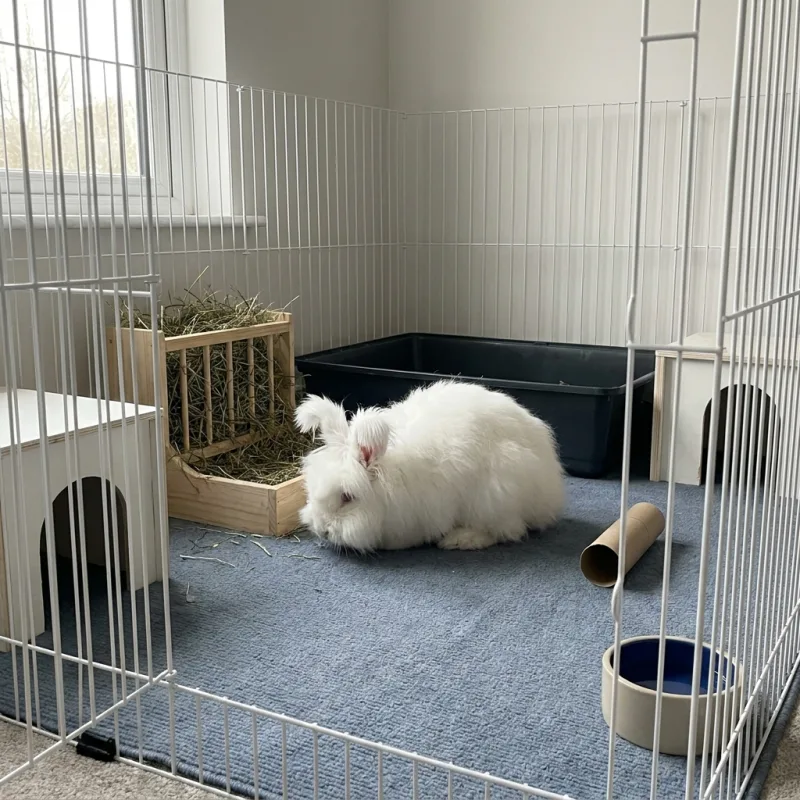
English Angora Rabbit
Small Pets · Rabbits

English Angora Rabbit

Oryctolagus cuniculus

A wool breed that demands near-daily groomingAdvanced

Lifespan
7-11 years
Weight
2.0-3.5 kg
Social needs
Social; keep in neutered bonded pairs
Time
Very high; daily care plus grooming
Cost
High
Diet
Unlimited hay, leafy greens, limited pellets

Overview

What is this animal?

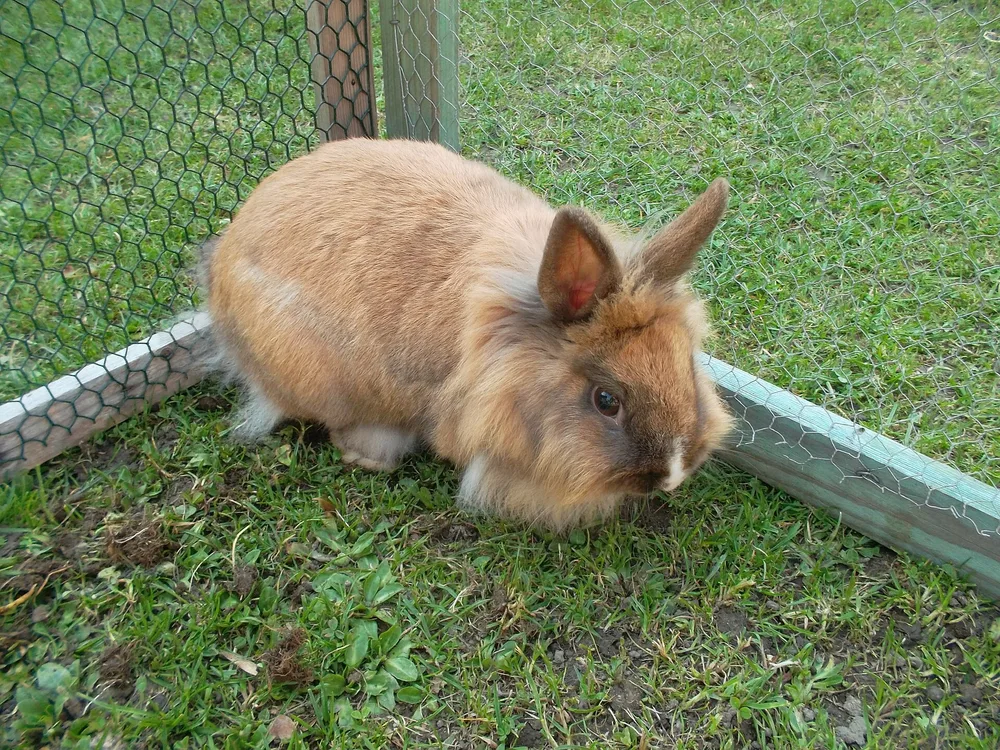
  • The English Angora is a wool breed covered in long, fine fibre from its ears to its feet, including the famous facial fringe.
  • It is kept both as a fibre animal and as a companion, but it is emphatically not a low-effort pet.
  • The coat grows continuously and must be groomed several times a week, with the wool clipped or plucked roughly every three to four months.
  • Anyone unwilling to commit to that schedule should choose a short-coated breed instead.

Temperament

  • English Angoras are generally docile and tolerant, partly because frequent grooming habituates them to handling from a young age.
  • Calm, routine sessions on a table or lap quickly become familiar.
  • They remain prey animals that prefer four feet on the ground, and they bond strongly with a neutered companion.
  • Neutering also improves litter habits and reduces uterine cancer in females.

A good fit for

  • Experienced keepers who enjoy grooming and fibre craft
  • Cool, indoor homes with clean, dry space
  • Owners with time for near-daily coat care
  • People wanting a docile, handleable rabbit

Common mistakes to avoid

  • Skipping grooming until mats and sores develop
  • Wool block: a silent, fast gut-stasis emergency
  • Overheating in full coat during warm weather
  • Underestimating the cost and time of clipping

Enclosure

Minimum 30,000 cm² of floor (4,650 sq in) — for the pair

Cannot be kept alone. The minimum is 2, and the space above is for that group.

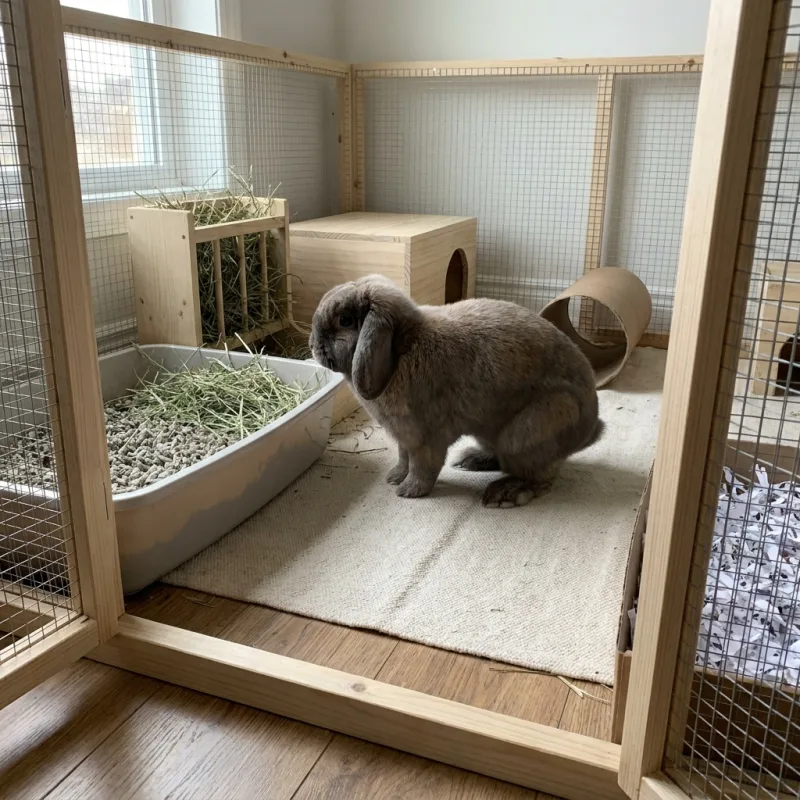
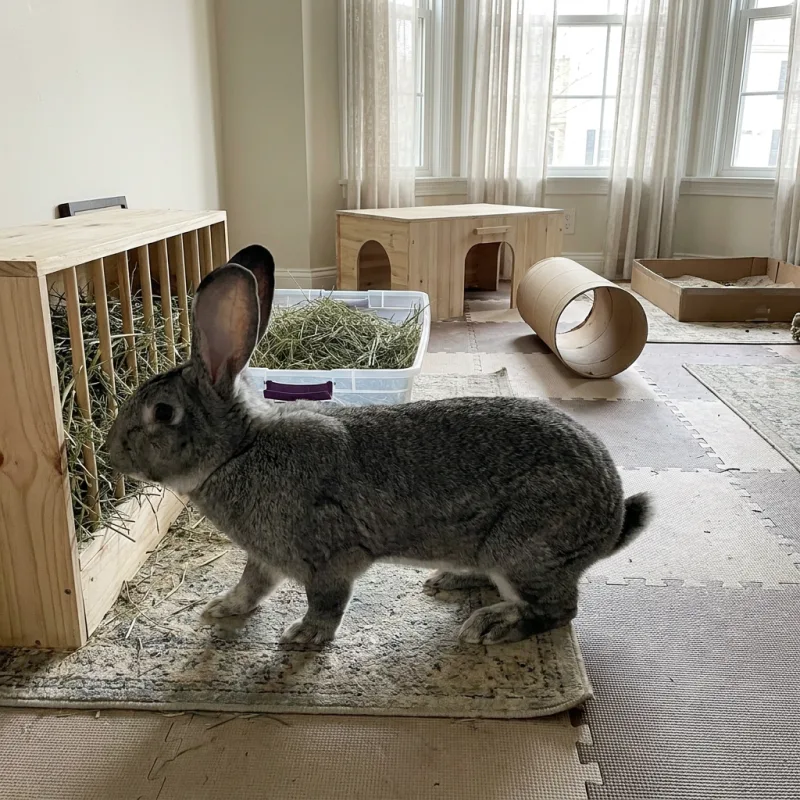
  • House indoors in a clean, dry pen or free-roam space of at least around 3 square metres for a pair, with soft, low-mess flooring that does not tangle into the coat.
  • Avoid straw and hay-storage setups that shed debris into the wool.
  • Keep Angoras cool: the dense coat makes them far more heat-sensitive than other rabbits, and anything above the mid-20s Celsius is dangerous in full coat.
  • Provide hides, a litter tray, and space to hop, stand, and stretch fully.

Check your enclosure

Supplies

Setup

  • Housing and secure exercise space
  • Litter trays, bowls, carrier, hides

Ongoing

  • Grass hay by the bale or the largest box available
  • Plain uniform adult rabbit pellets (no seeds, no coloured bits)
  • Mixed leafy greens for daily feeding
  • Heavy ceramic water bowl (tip-proof)
  • Hay rack or hay-filled litter tray
  • Eggcup or small scale for measuring pellets
  • Untreated willow or apple chews
  • Airtight bin to keep pellets fresh

Safe substrate: Paper-based litter in the tray, topped with hay · Fleece or washable mats on the living floor · Straw for outdoor warmth

Work out the cost

Care routine

Daily

  • Check droppings and appetite
  • Company and time out
  • Fresh greens and a measured pellet portion
  • Fresh water
  • Spot-clean the enclosure
  • Top up unlimited hay
  • Watch them while they are awake

Weekly

  • Change the litter trayevery 2 days
  • Brush out loose coatevery 3 days
  • Hands-on health check
  • Rotate enrichment
  • Weigh-in

Monthly

  • Deep-clean and change beddingevery 2 weeks
  • Check supplies and dates

Less often

  • Trim nailsevery 6 weeks

Vet: Annual exam, vaccinations and dental check — every 12 months (every 6 months from 5 years old)

Top resources for more info

Independent creators and organisations we would send a friend to. We have no affiliation with any of them, and nothing here is sponsored. Links checked 2026-09-19.

YouTubers

Sites

Go deeper

Diet

  • Unlimited grass hay is even more critical for wool breeds, because the fibre keeps swallowed wool moving through the gut.
  • Add daily leafy greens and a small measured portion of plain pellets.
  • Provide constant fresh water and avoid sugary treats.
  • Many keepers add extra long-strand fibre during moults, when wool ingestion peaks.

Health

  • Wool block is the breed's defining danger: swallowed fibre can slow or stop the gut, and any Angora that stops eating is an emergency.
  • Mats form quickly and pull painfully at the skin, inviting sores and flystrike, so the rear end must be checked daily in warm weather.
  • Clipping every few months, plus dental checks, vaccinations, and weight monitoring, makes the Angora one of the most maintenance-heavy small pets.
  • Budget for grooming tools and an exotics-savvy vet.

Is your enclosure big enough?

Minimum floor area30,000 cm² (4,650 sq in) of continuous, unbroken floor
CompanyCannot be kept alone. The minimum is 2, and the space above is for that group.

Is this urgent?

A rabbit that stops eating is an emergency, not a wait-and-see. Nothing else on this page is as time-critical.

Go now

Not eating, or not producing droppingsCall an exotics vet. Some sources treat 3 to 4 hours as the point to start worrying and 12 hours as an outright emergency; do not wait to find out which camp is right for your rabbit. Gut stasis can become life-threatening within 12 to 24 hours, and every hour of delay makes it harder to reverse.
8 hours
Hunched with the belly pressed to the floorGo now. A rabbit in this posture is in significant pain.
Now
Loud teeth grindingGo now. Distinct from the soft purr of a content rabbit. This is a pain signal.
Now
Hard, bloated abdomenGo now. Do not force-feed and do not massage. Bloat may need decompression rather than gut motility drugs, and the two treatments conflict.
Now
Maggots or fly eggs near the rearGo now. Flystrike. Check the rear twice a day in warm weather, every day, for every rabbit.
Now
Cannot cope with heat — panting, wet nose, lying flat and unresponsiveMove to shade, offer a wrapped cool pack, wet the ears, and go. Rabbits cannot pant effectively to cool themselves; distress starts around 28C and rises steeply.
Now

Today

Head tilt, or eyes flicking side to sideBook today. Outcomes are far better with early treatment.
Today
Weight down 50 g or more since last weekCall today with the weight history. Fur hides body condition completely. The scale sees it first.
Today

Two rabbits are the minimum, and a bonded pair will also tell you when something is wrong — a rabbit sitting apart from its partner is worth a second look.

This is general guidance for a healthy adult, not a diagnosis. An exotics vet who knows your animal always overrides it — and the time to find one is before you need one.

Can a english angora rabbit eat that?

Hay first, greens second, everything else barely at all. A rabbit fed mostly pellets and treats is a rabbit with dental disease waiting to happen.

The full list

Never (23)

AlcoholNo safe amount at any body weight on this site.
never
AvocadoPersin, concentrated in the skin, stone and leaves. Implicated in cardiac damage across birds, rodents and reptiles.
never
BindweedToxic, and it grows through hedges where people forage.
never
Bread and baked goodsRefined starch ferments in the hindgut and causes gas and stasis. No nutritional case for it either.
never
ButtercupProtoanemonin, an irritant toxin. Common in lawns, so check what you pick.
never
CaffeineCoffee, tea and energy drinks. Cardiac and neurological toxicity at tiny doses for an animal this size.
never
ChocolateTheobromine and caffeine. Small mammals and reptiles cannot clear either.
never
DairyAdults are lactose intolerant and the gut flora cannot handle it.
never
Dried fruitSugar concentrated several times over, and it sticks to the teeth. Most commercial small-pet treats are exactly this.
never
FoxgloveCardiac glycosides. Fatal.
never
GarlicSame allium toxicity as onion, and more concentrated by weight.
never
Iceberg lettuceAlmost entirely water with negligible nutrition, and it contains lactucarium, which causes diarrhoea in quantity. It displaces food that would have been useful.
never
LeekAllium family. Same mechanism as onion and garlic.
never
MeatA hindgut fermenter has no way to process animal protein. It disrupts the gut flora the animal depends on.
never
MushroomsNot part of any of these animals' natural diet, and the risk from misidentified varieties is not worth the zero upside.
never
NutsFat and phosphorus loads a herbivore is not built for, and a choking risk.
never
OnionOrganosulphur compounds damage red blood cells. The whole allium family is out.
never
PotatoSolanine in the skin and any green part, plus a starch load the hindgut cannot handle.
never
Raw beansLectins. Also a gas producer in a species that cannot vomit or belch.
never
RhubarbVery high in soluble oxalate, high enough to cause acute kidney injury. The leaves are worse than the stalks.
never
Salty or seasoned human foodSalt, oil and seasoning. Crisps, chips, seasoned leftovers and processed meat are all out.
never
SweetcornThe hulls are indigestible and are a recognised blockage risk in small herbivores.
never
Yogurt dropsSold in every pet shop for rabbits. Dairy plus sugar, and there is no version of this that is appropriate.
never

Rare treats (13)

AppleSugar. The seeds contain a cyanogenic compound and must be removed. A thin slice, once or twice a week. Never the seeds or core.
rare treat
BananaVery high in sugar and starch, and most animals will overeat it given the chance. A slice the width of a fingernail, rarely.
rare treat
BlueberrySugar, but a small portion size makes it easy to control. One or two berries, twice a week.
rare treat
Brussels sproutsHighly gas-forming. Half a sprout, rarely.
rare treat
CarrotSold as the archetypal rabbit food and it is nothing of the kind: carrot is a root vegetable with a high sugar content. The leafy tops, by contrast, are an excellent green. A thin slice as a treat. The tops can be fed freely.
rare treat
CauliflowerOne of the most gas-forming brassicas. A very small piece, occasionally.
rare treat
GrapesVery high in sugar. Halve them, because a whole grape is a choking hazard. One halved grape, rarely.
rare treat
OrangeAcidic and sugary; can irritate the mouth and gut. A tiny segment, rarely if at all.
rare treat
PearSugar. Remove the seeds. A thin slice occasionally.
rare treat
PeasHigh in starch and sugar. The pods and leaves are better than the peas. A few pods occasionally.
rare treat
StrawberrySugar, though lower than most fruit. The leaves are actually the better part. Half a small berry, once or twice a week.
rare treat
TomatoThe ripe flesh is safe in small amounts. The leaves, stems and any green fruit contain solanine and must never be offered. A small piece of ripe flesh, occasionally. Never the plant.
rare treat
WatermelonSugar and a very high water content, which together can loosen the gut. Remove the seeds. A small cube in hot weather, rarely.
rare treat

Occasional (18)

BasilSafe and well liked. Rotate rather than relying on it. A few leaves.
occasional
Bok choyGood green, mildly goitrogenic like other brassicas. A leaf or two a few times a week.
occasional
BroccoliNutritious but a notable gas producer. Leaves and stalk are better tolerated than the florets. A small floret or a piece of stalk, twice a week.
occasional
CabbageA brassica. Gas-forming in quantity, and goitrogenic with heavy long-term feeding. A small piece, once or twice a week.
occasional
CelerySafe and well liked. Cut across the stalk so the long fibres cannot catch. A short piece, cut into segments.
occasional
ChardSame oxalate issue as spinach. A small leaf, occasionally.
occasional
CourgetteSafe and mild. Serve raw. A few slices a few times a week.
occasional
CucumberSafe, but it is mostly water with very little in it. Useful for hydration in warm weather, poor as a staple. A few slices.
occasional
DillSafe in rotation. A few fronds.
occasional
Green beansSafe cooked or raw in small amounts. Gas-forming in quantity. One or two, occasionally.
occasional
KaleHigh in calcium and a mild goitrogen. Genuinely nutritious, but not the everyday green it is often sold as. A leaf or two, two or three times a week.
occasional
MintSafe in small amounts; strongly flavoured and not every animal wants it. A leaf or two.
occasional
ParsleyNutritious but relatively high in calcium. Fine in rotation, not as the whole green portion. A few sprigs, a few times a week.
occasional
PelletsA uniform pelleted nugget, not a muesli mix. Muesli lets a rabbit pick out the sweet bits and leave the fibre, which is how dental disease starts. An eggcup per rabbit per day, no more.
occasional
PumpkinSafe and well tolerated in small amounts. A small cube occasionally.
occasional
RocketPeppery and well tolerated in rotation. A small handful, a few times a week.
occasional
SpinachHigh in oxalates, which bind calcium and contribute to bladder sludge and stones in animals prone to them. A single small leaf, no more than once or twice a week.
occasional
WatercressNutritious, strongly flavoured, high in calcium. A small handful occasionally.
occasional

Everyday foods (9)

Bell pepperOne of the best everyday vegetables here: high in vitamin C, low in sugar, no oxalate problem. Remove the seeds and stalk. A few strips daily.
everyday food
Bramble leavesBlackberry leaves are excellent forage and rabbits take them readily. A few leaves daily.
everyday food
Carrot topsThe leaves are a proper green and much better food than the root. A handful as part of the daily greens.
everyday food
CorianderWell tolerated, aromatic, and most animals take it readily. Part of a daily mixed handful.
everyday food
Dandelion leavesOne of the best greens available, and free. Pick well away from roadsides and anywhere that may have been sprayed. A generous handful daily.
everyday food
GrassFresh growing grass is excellent. Lawn clippings are not: they ferment in the bag and cause severe gut upset. As much as they will graze. Never mown clippings.
everyday food
Grass hayShould be about 80 percent of what this animal eats, available at all times. It is what wears the teeth down and what keeps the gut moving. Unlimited, always.
everyday food
PlantainA common lawn weed and one of the better forage plants. A handful daily.
everyday food
Romaine lettuceDark leafy lettuce with real nutritional content and a good water balance. A generous handful daily as part of a mixed selection.
everyday food

That plant or food is not on our list. Do not offer it — a rabbit cannot vomit, so anything that goes in has to go all the way through. Check with an exotics vet.

A rabbit that has not eaten for 8 hours needs a vet, whatever the reason. Diet changes are the most common trigger for that, which is why new foods go in one at a time.

What it really costs

Setup, monthly, first year and across a whole life, itemised and with the electricity worked out from the actual wattage. Published figures for the same animal disagree by a factor of four, so the calculator shows ranges rather than picking one.

Bedding and substrate

Rabbits need a clean, dry, non-slip floor plus a separate deep litter tray. The two jobs need two materials.

Safe

Paper-based litter in the tray, topped with hayRabbits eat while they toilet. Hay over paper litter serves both habits.
safe
Fleece or washable mats on the living floorNon-slip, warm, and washable.
safe
Straw for outdoor warmthInsulating, and different from hay: straw is bedding, hay is food. An outdoor rabbit needs both.
safe

With a caveat

Wood pelletsVery absorbent in a tray, uncomfortable underfoot as a floor.
with a caveat

Never

Clumping cat litterSwallowed while grooming and eating, and it clumps internally.
never
Pine and cedar shavingsAromatic phenols; airway irritation in a species already prone to respiratory disease.
never
Wire mesh floorsCauses sore hocks. Rabbits have no protective pad on the underside of the foot.
never

Check and clean the rear daily in warm weather. A soiled or damp rear is what flystrike needs.

Compare with other animals

The same axes for every animal, side by side — the way the guides are written makes that a fair comparison rather than two articles.

Compare with up to three other animals →

Keep going

Rabbits, side by side

Same axes, same care guides — the honest way to choose between types.

See all Rabbits side by side →
More Small Pets guides