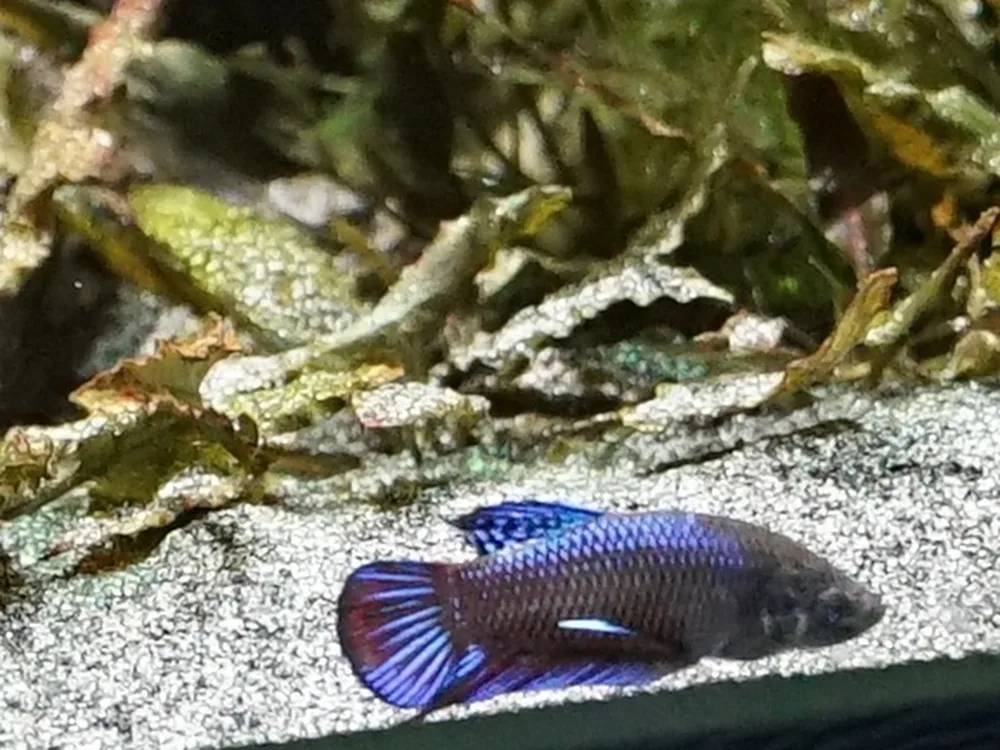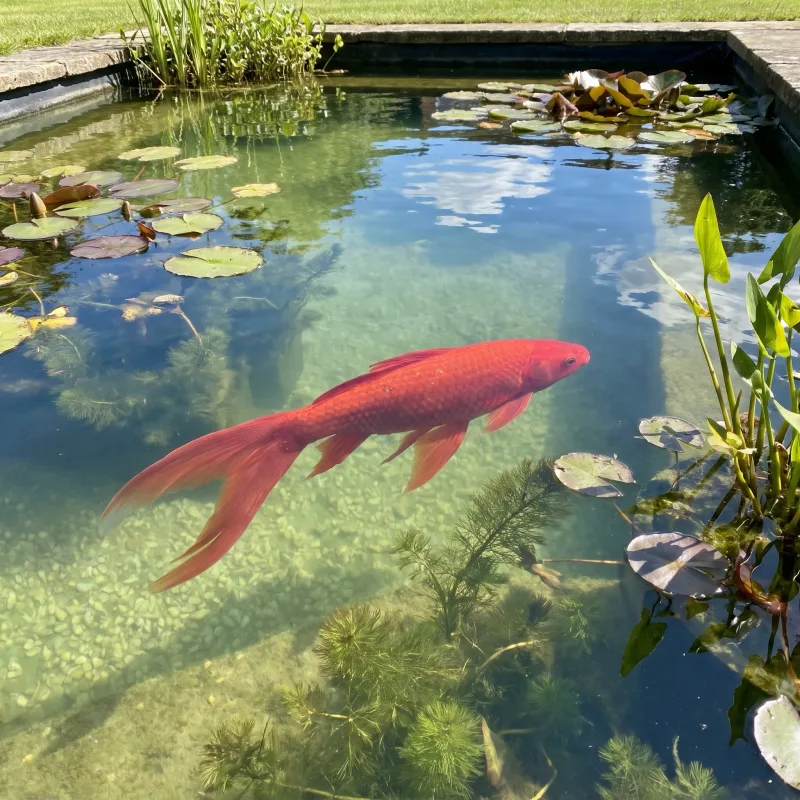
Comet Goldfish
Freshwater Fish · Goldfish

Comet Goldfish

Carassius auratus

Slim, fast pond goldfish with a long forked tailAdvanced

Lifespan
10-20+ years
Size
12-14 in
Social needs
Social; keep 5+ goldfish together
Time
Moderate-high (heavy waste, pond upkeep)
Cost
High
Diet
Omnivore (sinking pellets, blanched greens, less in cold water)

Overview

What is this animal?

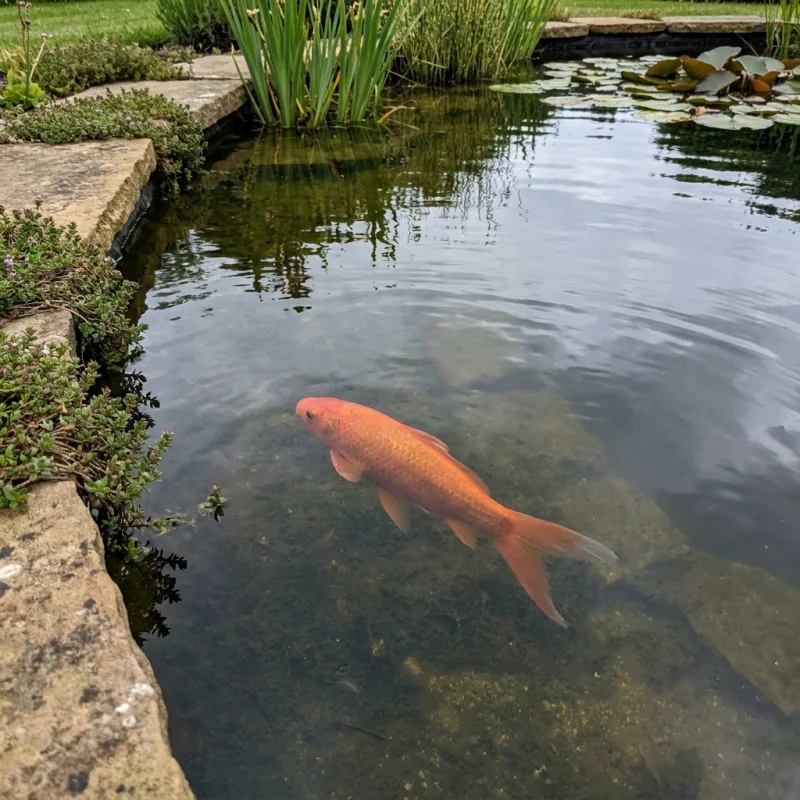
  • The comet is a single-tailed goldfish developed in the United States in the 1880s from the common goldfish, and first seen in the ponds of the US Fish Commission in Washington, DC.
  • It is slimmer than a common goldfish, with a long, deeply forked single tail that the UK breed standard asks to be about three-quarters as long as the body.
  • Comets are hardy, active and long-lived: they regularly reach 12 in, can reach 14 in, and can live 10-20 years.
  • They are sold cheaply as small juveniles, but an adult comet is a pond fish that needs a garden pond, or an aquarium as big as one.

Temperament

  • Comets are peaceful, social and very active, and they jostle for food at feeding time.
  • Keep a group of at least five, never one alone.
Show 2 more
  • They are fast swimmers that outcompete slow, round-bodied fancy goldfish for food, so never mix the two: in a study of four goldfish forms, comets swam as efficiently as commons, while the round-bodied forms used about twice the energy to cover the same distance.
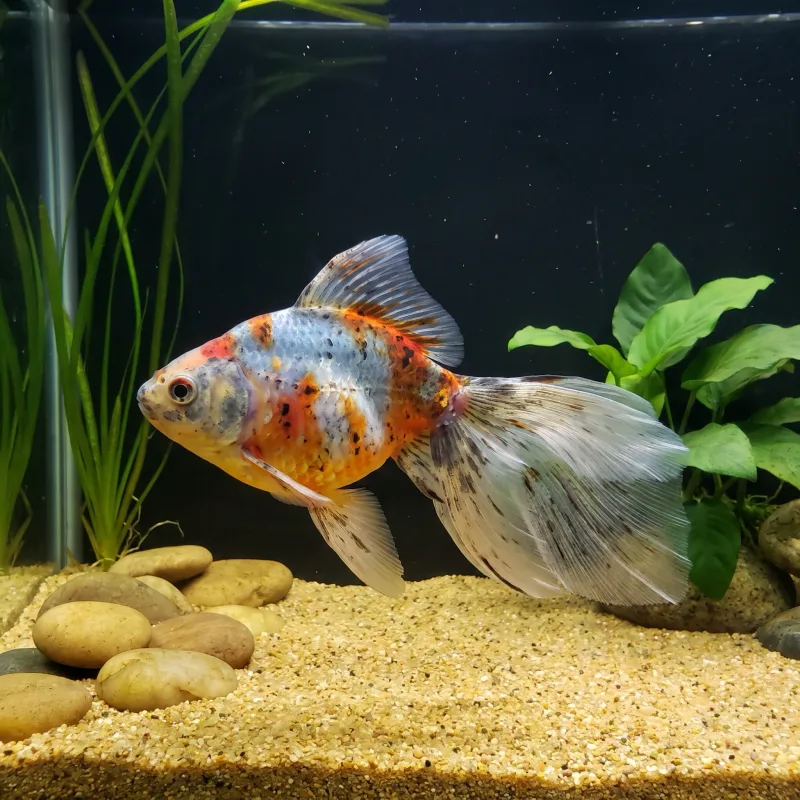
  • Commons, shubunkins and other single-tails of a similar size are the right company, and tiny fish will be eaten.

A good fit for

  • Pond keepers with room for a large, deep garden pond
  • Keepers who want an active, hardy coldwater fish
  • Single-tail ponds with commons or shubunkins
  • People committed to 10-20+ years of care

Common mistakes to avoid

  • Being sold as a small, cheap tank fish
  • Mixing with slow, round-bodied fancy goldfish
  • Underestimating 12-14 in adults and the pond they need
  • Torn tails from sharp decor or fin-nippers

Enclosure

Minimum 680 gallons, for a group of 5

Cannot be kept alone. The minimum is 5, and the space above is for that group.

  • Comets are coldwater fish that do best at about 50-68°F, need no heater, and tolerate the seasonal swings of an outdoor pond.
  • Give a group of at least five a garden pond or tank at least 11.5 ft long with at least 3.5 ft of water, about 680 US gallons or more, fully cycled and with strong filtration rated above its volume.
  • The length is ten times, and the depth three times, the full adult length of the largest fish, here 14 in; comets that stay at 12 in need 10 ft and 35 in.
Show 3 more
  • A tank that size is a custom build, which is why a pond is the usual home for comets.
  • Keep ammonia and nitrite at zero and nitrate low with regular partial water changes, in slightly hard, alkaline water of about pH 7.5-8.5.
  • Use smooth stones and plants rather than sharp decor, net the pond against herons, and never keep a comet in a bowl or a small tank.

Check your enclosure

Supplies

Setup

  • Pond liner and underlay
  • Pond pump
  • Pond filter with UV clarifier
  • Edging, plants and predator netting
  • Liquid test kit
  • Dechlorinator and starter supplies

Ongoing

  • Sinking goldfish pellets or gel food
  • Frozen peas (to deshell and blanch)
  • Courgette and spinach for blanching
  • Veg clip
  • Frozen bloodworm or daphnia
Show 2 more
  • Small cup for pre-soaking pellets
  • Fine net for removing leftovers

Safe substrate: Fine, smooth sand · Smooth, rounded fine gravel (not for loaches or sand-sifting cichlids; sand is better for corydoras) · Bare bottom (quarantine and grow-out only)

Work out the cost

Care routine

Daily

  • Check temperature and equipment
  • Feed a sinking, pre-soaked food
  • Head-count and look everyone over

Every few days

  • Top up evaporationevery 3 days

Weekly

  • Large water change
  • Test the water
  • Wipe the front glass only
Show 4 more

Every few weeks

  • Rinse the filter mediaevery 2 weeks
  • Trim and thin the plantsevery 2 weeks

Monthly

  • Check supplies and reagent dates
  • Replace or recharge chemical media, if you use any (skip it in a blackwater tank)

Health review: Quarterly water and buoyancy review, every 3 months

Tools

Care in depth

Diet

Omnivore (sinking pellets, blanched greens, less in cold water)
  • Comets are omnivores that always act hungry, so they are easy to overfeed.
  • Feed a quality sinking goldfish pellet as the staple, with blanched vegetables such as peas, courgette and spinach, and occasional frozen bloodworm or daphnia.
  • Feed small amounts once or twice a day, only what they finish in a couple of minutes.
  • In a pond, cut feeding right back once the water cools below about 46°F, because goldfish digest food poorly in the cold.

Health

Signs of good health, and the common problems
  • Comets are hardy, and most of their problems trace back to the water: fin rot, white spot (ich) and other infections follow an undersized system, weak filtration or overfeeding.
  • Watch for clamped or ragged fins, gasping at the surface, flashing against decor, and white spots on the body and fins.
  • Keep sharp decor and fin-nipping fish away from that long tail.
  • Quarantine new fish for 2-4 weeks before they join a pond or tank, because a disease brought in puts every fish there at risk.

Is this urgent?

6 warning signs and how fast to act, 3 of them right away

In a fish tank the patient is usually the water. Test before you treat: dosing a healthy tank for a disease it does not have makes things worse.

Go now

Any detectable ammonia or nitrite in a stocked tankLarge water change now with dechlorinated, temperature-matched water. Stop feeding. Test again in 12 hours. Both are directly toxic. How toxic the ammonia reading is depends on pH and temperature, so the same number can be harmless or lethal.
Now
Fish gasping at the surface with fast gill movement, or crowding the filter outflowIncrease surface movement now (gently in a betta or gourami tank, without creating a strong current), then test the water. Either the oxygen has crashed or the gills are being chemically burned. Both are hours-scale problems. Bettas, gouramis and corydoras rise to gulp air as part of normal breathing; the warning is constant gulping, fast gill movement, or the whole group hanging at the top.
Now
Sudden deaths, more than one fish in a dayTest ammonia, nitrite, nitrate and temperature before doing anything else. Do not add medication yet. Multiple simultaneous deaths usually point at the water or the equipment rather than a pathogen, so rule those out first.
Now

Today

Flashing: repeatedly scraping against decor or substrateTest the water, then look closely for parasites. Irritation is either chemical or parasitic; the test tells you which before you medicate.
Today
White salt-grain spots over the body and finsBegin the appropriate treatment today and check the temperature. The parasite's life cycle is temperature-driven, and it multiplies with every cycle you wait.
Today

Soon

Clamped fins, hiding, or refusing food for more than two daysTest the water and review recent changes. Usually the earliest visible sign of a parameter drifting.
A few days

Never add a new fish to a tank that is not fully cycled, and never treat blind. A test kit is cheaper than the fish.

This is general guidance for a healthy adult, not a diagnosis. An exotics vet who knows your animal always overrides it, and the time to find one is before you need one.

Bedding and substrate

3 safe, 4 with a caveat, 2 to avoid

Substrate in an aquarium is a filter as much as a floor. Most of the biology lives in and on it.

Safe

Fine, smooth sandCorrect for corydoras, kuhli loaches, eartheaters such as rams and acaras, and anything else that sifts or burrows. Barbels wear away on sharp gravel.
safe
Smooth, rounded fine gravel (not for loaches or sand-sifting cichlids; sand is better for corydoras)Rinse thoroughly before use. Grain size should be too large to swallow and too small to trap food. Kuhli loaches need sand to burrow into and rams and acaras sift mouthfuls of it; bronze and panda corydoras manage on smooth fine gravel, but sterbai corydoras need sand.
safe
Bare bottom (quarantine and grow-out only)Legitimate for quarantine and grow-out tanks. Easy to clean, but it holds far less biological filtration, and it is no long-term home for burrowing loaches or sand-sifters.
safe

With a caveat

Crushed coral or aragoniteDeliberately raises hardness and pH. Correct for rift-lake cichlids, wrong for soft-water species.
with a caveat
Aquasoil for planted tanksExcellent for plants, but most active soils soften the water and pull pH and KH down for months, and many leach ammonia for the first weeks. Right for soft-water species; wrong for hard-water animals (livebearers, rainbowfish, goldfish, and snails, whose shells erode in soft, acidic water) unless you test GH and KH and remineralise. Cycle around it; do not stock into it.
with a caveat
Very deep sand bedsAnaerobic pockets form below about 2 inches in still sand. Either keep it shallow or keep it stirred.
with a caveat
Painted or coated gravelUsually fine, but coatings chip. Test a handful in a jar for a week first.
with a caveat

Never

Sharp or angular gravel with bottom-dwellersWears down barbels and leads to infection in corydoras and loaches.
never
Anything containing metal, limestone of unknown origin, or shells in a soft-water tankSlowly alters chemistry in ways that are hard to diagnose later.
never

This is our general list for freshwater fish. We have not built one specific to Goldfish yet.

Top resources for more info

Independent creators and organisations we would send a friend to. We have no affiliation with any of them, and nothing here is sponsored. Links checked 2026-10-22.

YouTubers

Sites

Keep going

Goldfish, side by side

Same axes, same care guides: the honest way to choose between types.
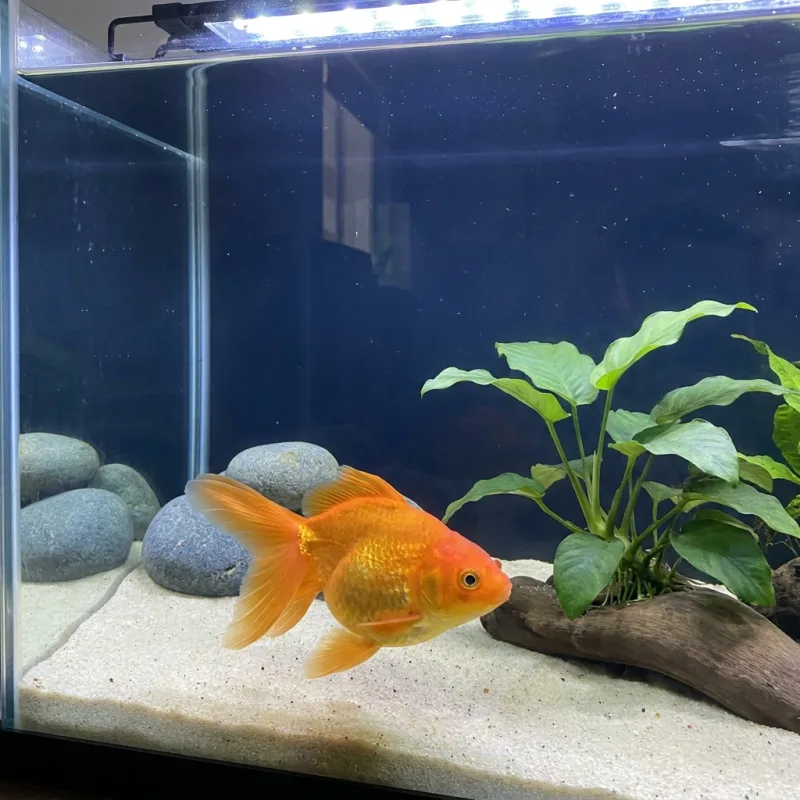
More Freshwater Fish guides

Is your enclosure big enough?

These are the smallest sizes that give good conditions, not legal minimums. More room is always better.

Minimum 680 gallons, for a group of 5

Every figure, and where it comes from

680 gallons is for a group of five comet goldfish, in a pond or tank at least 11.5 ft long with at least 3.5 ft of water. Austrian law requires a goldfish tank or pond at least ten times as long, and three times as deep, as the full adult length of its largest fish, and at least five goldfish kept together. A comet's full adult length is 14 in, the size Practical Fishkeeping gives. The welfare-led sources ask for less in an aquarium, and most say a pond is better; this site sets its figure at that legal minimum because good conditions are never less than a law requires. Comets that stay at 12 in, the size most sources give, need 10 ft and 35 in.

Minimum volume680 gallons
Swimming length11.5 ft minimum. A tall tank of the right volume is still the wrong shape.
CompanyCannot be kept alone. The minimum is 5, and the space above is for that group.
The recognised standards do not agree on this one
Austria, 2. Tierhaltungsverordnung, Anlage 5: A tank or pond at least 10 times as long and 3 times as deep as the full adult total length of the largest fish, and at least five goldfish kept together. A legal minimum. The welfare-led sources ask for less, so this is the length, depth and group this site uses: good conditions are never less than a law requires. Checked 2026-10-23.
Practical Fishkeeping (UK), comet goldfish profile: Grows to 14 in and regularly reaches 12 in; best in a filtered outdoor pond or a very large aquarium, indoors preferably at least 47 in long and best 5-6 ft long term. Its 14 in is the adult length behind the figure used here. Its tank lengths are less, and it favours a pond. Checked 2026-10-23.
SPCA New Zealand: Slim-bodied goldfish such as commons, comets and shubunkins can grow to about 12 in and are best suited to outdoor ponds. In favour of a pond, like the figure used here. Checked 2026-10-23.
Fish Tank Advisor (US fishkeeping guide): 75 US gal for one comet goldfish and 50 US gal for each extra, in a school of five or more; a pond for a school. Less than the figure used here: about 275 gallons for five. Checked 2026-10-23.
Swiss Animal Protection STS: A goldfish aquarium at least 47 in long and 20 in wide; goldfish are shoaling fish and must not be kept alone. Less than the figure used here. Checked 2026-10-23.
RSPCA Australia: Length at least 4 times, width 2 times and height 3 times the adult body length, and never under 13 gallons. Its width, 28 in for a 14-inch fish, is the width behind the volume used here; its length is less. Checked 2026-10-23.

What it really costs

Setup, monthly, first year and across a whole life, itemised and with the electricity worked out from the actual wattage. Published figures for the same animal disagree by a factor of four, so the calculator shows ranges rather than picking one.

My kit says 0.25 ppm. Is that dangerous?

A liquid kit measures total ammonia, but only the un-ionised fraction is really toxic, and that fraction is governed by pH and temperature. Each whole pH unit multiplies it roughly tenfold. So the same reading can be nearly harmless in one tank and lethal in another; this works out which one you are in.