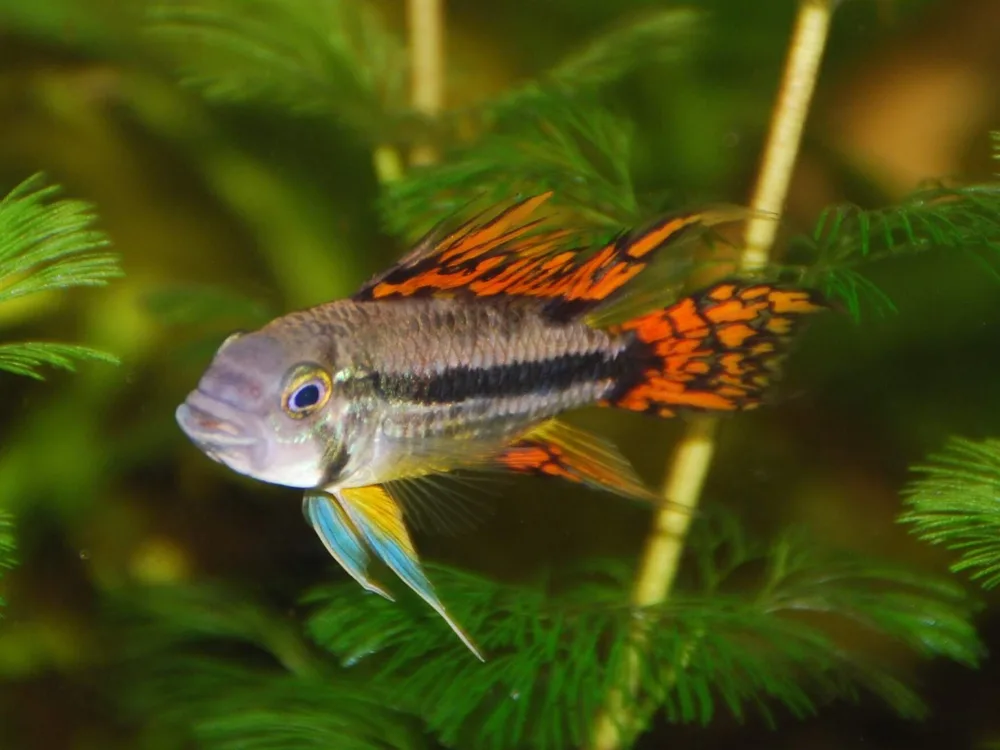
Made be Uploader · CC BY-SA 3.0 — Wikimedia Commons (cropped)
Cockatoo Dwarf Cichlid
Apistogramma cacatuoides
Big cichlid personality in a nano-friendly bodyIntermediate
- Lifespan
- 3-5 years
- Size
- Males 8cm, females 5cm
- Social needs
- Pair or harem; one male per tank
- Time
- 10-15 min daily; weekly water change
- Cost
- Medium
- Diet
- Carnivore-leaning omnivore (frozen, micro-pellet)
Overview
What is this animal?
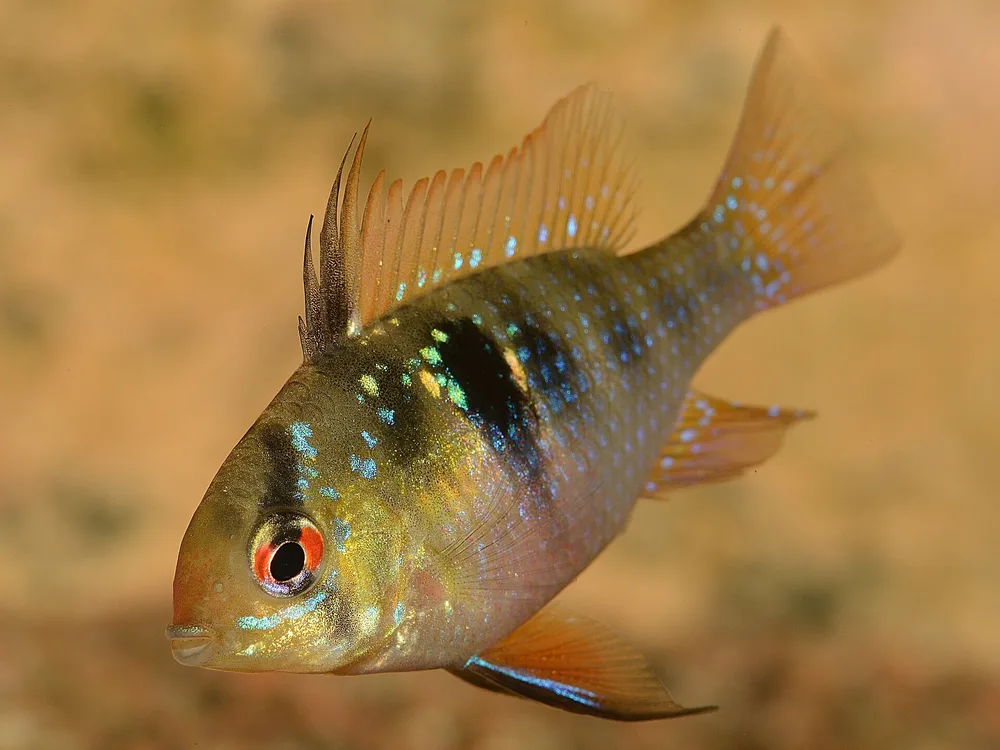
- The cockatoo dwarf cichlid is the gateway Apistogramma: males flare a spiked, cockatoo-crest dorsal fin and tail edged in flame orange, while staying small enough for modest tanks.
- Tank-bred lines are hardy and widely available.
- They deliver everything people love about cichlids — territory, courtship, brood care, intelligence — at a scale that fits a 60-litre planted aquarium.
Temperament
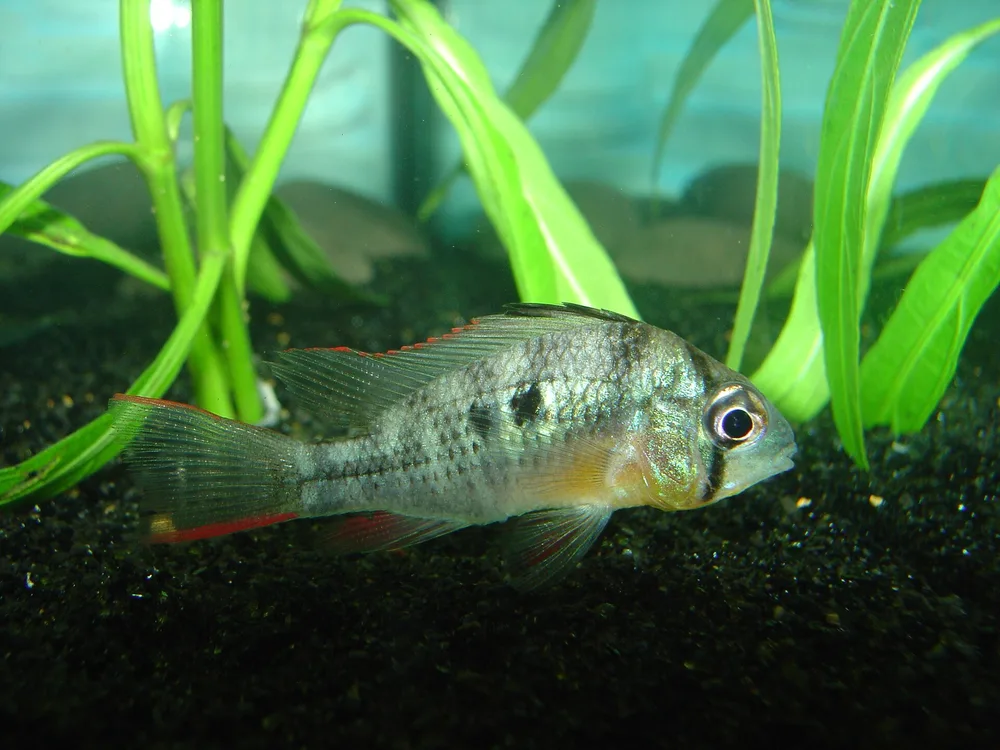
- Expect theatre: males patrol and display, females turn brilliant yellow and run the cave, and a brooding mother herding fry across the sand is one of the hobby's best sights.
- Aggression is real but mostly posturing in well-furnished tanks.
- They ignore peaceful midwater fish such as small tetras and rasboras, which actually help shy apistos feel safe.
- Skip other bottom-territory cichlids in smaller tanks, and expect shrimp fry to be eaten.
A good fit for
- Keepers ready for a first dwarf cichlid
- Planted tanks with sand, wood, and leaf litter
- Aquarists who want courtship and brood care
- Communities with small, peaceful schooling fish
Common mistakes to avoid
- Two males in anything but a very large tank
- Bare tanks with no caves — bullying follows
- Old water: apistos resent nitrate buildup
- Keeping with shrimp and expecting shrimplets to survive
Enclosure
Minimum 60 litres (16 US gallons) — for the pair
Cannot be kept alone. The minimum is 2, and the space above is for that group.
- A pair needs 60 litres (15 gallons) or more of floor-focused space: fine sand to sift, leaf litter, wood, and at least two caves, because territory is negotiated around hideouts.
- A male with several females needs proportionally more floor and more caves.
- Keep 24-27C with gentle flow.
- Wild fish demand soft, acidic water, but tank-bred cockatoos accept neutral and moderately hard conditions; stability and low nitrate matter more than chasing numbers.
Supplies
Setup
- Tank and stand
- Filter
- Heater and thermometer
- Substrate, plants and decor
- Liquid test kit
- Dechlorinator and starter supplies
Ongoing
- Quality cichlid pellet sized to your species
- Tropical flake as a secondary staple
- Frozen bloodworm, brine shrimp and daphnia
- Spirulina or vegetable flake
- Live blackworms for conditioning (optional)
- Small thawing cup
- Turkey baster for target-feeding shy fish
- Fine net for removing leftovers
Safe substrate: Inert aquarium gravel · Fine, smooth sand · Aquasoil for planted tanks
Care routine
Daily
- Check temperature and equipment
- Feed
- Head-count and look everyone over
Weekly
- Frequent partial water changeevery 3 days
- Top up evaporationevery 3 days
- Check territories and pairing
- Clean glass and clear algae
- Test the water
Monthly
- Trim and thin the plantsevery 2 weeks
- Check supplies and reagent dates
- Rinse the filter media
Less often
- Replace chemical filter media (Carbon/Purigen)every 2 months
Vet: Quarterly water and territory review — every 3 months
Top resources for more info
Independent creators and organisations we would send a friend to. We have no affiliation with any of them, and nothing here is sponsored. Links checked 2026-09-19.
YouTubers
Sites
Go deeper
Diet
- Feed meaty foods sized for a small mouth: frozen or live baby brine shrimp, daphnia, cyclops, and chopped bloodworm, alongside a quality sinking micro-pellet.
- They feed from the substrate and midwater, not the surface.
- Condition breeding pairs with extra live or frozen food.
- Vary the diet — colour and finnage visibly respond to it.
Health
- Tank-bred stock is robust; most failures are social or environmental — a bullied female with nowhere to hide, or old, nitrate-heavy water.
- Generous cover and steady water changes prevent both.
- Quarantine new fish, and treat the species as medication-sensitive: dose carefully and avoid copper-heavy products where possible.
Is your enclosure big enough?
Is this urgent?
In a fish tank the patient is usually the water. Test before you treat — dosing a healthy tank for a disease it does not have makes things worse.
Go now
Today
Soon
Never add a new fish to a tank that is not fully cycled, and never treat blind. A test kit is cheaper than the fish.
This is general guidance for a healthy adult, not a diagnosis. An exotics vet who knows your animal always overrides it — and the time to find one is before you need one.
What it really costs
Setup, monthly, first year and across a whole life, itemised and with the electricity worked out from the actual wattage. Published figures for the same animal disagree by a factor of four, so the calculator shows ranges rather than picking one.
Bedding and substrate
Substrate in an aquarium is a filter as much as a floor. Most of the biology lives in and on it.
Safe
With a caveat
Never
This is our general list for freshwater fish. We have not built one specific to Cichlids yet.
My kit says 0.25 ppm. Is that dangerous?
A liquid kit measures total ammonia, but only the un-ionised fraction is really toxic, and that fraction is governed by pH and temperature — each whole pH unit multiplies it roughly tenfold. So the same reading can be nearly harmless in one tank and lethal in another; this works out which one you are in.
Compare with other animals
The same axes for every animal, side by side — the way the guides are written makes that a fair comparison rather than two articles.
Cichlids, side by side
Same axes, same care guides — the honest way to choose between types.
See all Cichlids side by side →