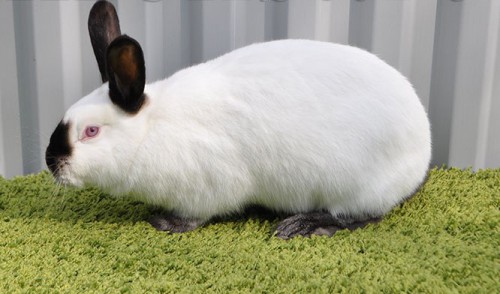
Californian Rabbit
Oryctolagus cuniculus
A sturdy, placid breed in Himalayan pointsIntermediate
- Lifespan
- 5-10 years
- Weight
- 3.6-4.8 kg (8-10.5 lb); does run larger than bucks
- Social needs
- Social; keep in neutered bonded pairs
- Time
- Daily; 1-2 hours of feeding, cleaning and floor time
- Cost
- Moderate to high
- Diet
- Unlimited grass hay, daily greens, strictly measured pellets
Overview
What is this animal?
- The Californian was developed in the 1920s by George West in Southern California as a dual-purpose meat and fur breed, combining Himalayan, Standard Chinchilla and New Zealand White stock.
- It is a large, muscular rabbit with a white body, near-black points on the nose, ears, feet and tail, and ruby-pink eyes.
- The pointed pattern is temperature-sensitive, so the markings darken in cold weather and fade in warm spells, and kits are born almost entirely white.
- As a companion it is calm, solidly built and less delicate than the dwarf and lop breeds, but at 3.6-4.8kg it needs space, food and equipment at large-rabbit scale.
- Because it remains a common commercial and 4-H breed, Californians turn up in rescues regularly, so check adoption before buying.
- They are not a low-effort starter pet, and they need the same decade-long commitment, companionship and rabbit-savvy vet care as any other rabbit.
Temperament
- Californians are widely regarded as one of the calmer, steadier rabbit breeds, and well-socialised adults are placid, curious and tolerant of quiet company.
- They are still prey animals that generally dislike being lifted, so interact at floor level and let the rabbit come to you.
- Their hindquarters are powerful, and a struggling Californian can scratch a handler or injure its own spine, so children should never carry one.
- They suit patient households that enjoy calm, ground-based companionship rather than a cuddly lap pet.
- They are social and should live with a bonded, neutered companion rabbit.
- Most litter-train easily, learn routines quickly and become confident free-roam house rabbits when given consistent, gentle handling.
A good fit for
- Keepers wanting a calm, sturdy large rabbit
- Homes with generous permanent floor space
- Adopters willing to check rescues first
- Families with gentle older children
- Those preferring a low-grooming flyback coat
Common mistakes to avoid
- Hutch or cage housing far too small for the breed
- Fast weight gain on unmeasured pellets
- Sore hocks from hard, wire or dirty flooring
- Overheating above about 25°C (77°F)
- Children picking up a strong, kicking rabbit
- Keeping this social breed alone
Enclosure
Minimum 60,000 cm² of floor (9,300 sq in) — for the pair · 300 × 200 cm
Cannot be kept alone. The minimum is 2, and the space above is for that group.
- A pair needs a permanently accessible base of at least 3x2m (10x6ft) of floor space with 1m (3ft) of height, such as a rabbit-proofed room or large floor pen, plus daily access to a bigger exercise space.
- Traditional hutches and pet-shop cages are far too small for a breed this size, and a Californian must always be able to take several full hops, stand upright on its hind legs and stretch out flat.
- Their weight makes soft, non-slip flooring important, so avoid wire, bare hard floors and thin bedding, which cause sore hocks.
- Provide oversized litter trays, sturdy hides, tunnels and chew items, and keep cables and skirting protected indoors.
- Keep them cool and shaded, because rabbits struggle above about 25°C (77°F) and this heavy-bodied breed overheats faster than small ones.
- Ruby-eyed rabbits can also be sensitive to harsh bright light, so always offer dim retreats.
Supplies
Setup
- Housing and secure exercise space
- Litter trays, bowls, carrier, hides
Ongoing
- Grass hay by the bale or the largest box available
- Plain uniform adult rabbit pellets (no seeds, no coloured bits)
- Mixed leafy greens for daily feeding
- Heavy ceramic water bowl (tip-proof)
- Hay rack or hay-filled litter tray
- Eggcup or small scale for measuring pellets
- Untreated willow or apple chews
- Airtight bin to keep pellets fresh
Safe substrate: Paper-based litter in the tray, topped with hay · Fleece or washable mats on the living floor · Straw for outdoor warmth
Care routine
Daily
- Check droppings and appetite
- Company and time out
- Fresh greens and a measured pellet portion
- Fresh water
- Spot-clean the enclosure
- Top up unlimited hay
- Watch them while they are awake
Weekly
- Change the litter trayevery 2 days
- Brush out loose coatevery 3 days
- Hands-on health check
- Rotate enrichment
- Weigh-in
Monthly
- Deep-clean and change beddingevery 2 weeks
- Check supplies and dates
Less often
- Trim nailsevery 6 weeks
Vet: Annual exam, vaccinations and dental check — every 12 months (every 6 months from 5 years old)
Top resources for more info
Independent creators and organisations we would send a friend to. We have no affiliation with any of them, and nothing here is sponsored. Links checked 2026-09-19.
YouTubers
Sites
Go deeper
Diet
- Unlimited fresh grass hay must make up around 85% of the diet, with a daily adult-handful portion of varied leafy greens.
- Feed plain uniform pellets strictly measured at no more than an eggcupful (about 25g) per kilogram of body weight daily, and reduce that if weight creeps up.
- The breed was selected for fast growth and efficient feed conversion, so Californians gain fat quickly on free-fed pellets, muesli mixes or sugary treats.
- Obesity in a rabbit this heavy directly worsens sore hocks, grooming problems and gut trouble.
- Offer water in a heavy, tip-proof bowl as well as any bottle, since large rabbits drink a lot.
- Introduce new greens gradually and skip fruit except as an occasional tiny treat.
Health
- Sore hocks (pododermatitis) are the main breed-linked risk, driven by their body weight on hard or dirty flooring, so check the hind feet weekly.
- Gut stasis is an emergency in all rabbits, and any drop in appetite or droppings needs a vet the same day.
- Their white rump also shows soiling clearly, which helps you catch the wet fur that invites flystrike in warm months.
- Unlike the dwarfs and lops on this site, the Californian's longer commercial head shape makes congenital dental problems less common, but constant hay wear is still essential.
- Spay does, because uterine adenocarcinoma affects the majority of unspayed females by five or six years old, and neuter bucks for bonding.
- In the UK and Europe, vaccinate annually against myxomatosis, RHD1 and RHD2; in North America, ask your vet about the RHDV2 vaccine.
- Budget for larger drug doses at this body weight and choose a rabbit-experienced practice before you need one.
Is your enclosure big enough?
Is this urgent?
A rabbit that stops eating is an emergency, not a wait-and-see. Nothing else on this page is as time-critical.
Go now
Today
Two rabbits are the minimum, and a bonded pair will also tell you when something is wrong — a rabbit sitting apart from its partner is worth a second look.
This is general guidance for a healthy adult, not a diagnosis. An exotics vet who knows your animal always overrides it — and the time to find one is before you need one.
Can a californian rabbit eat that?
Hay first, greens second, everything else barely at all. A rabbit fed mostly pellets and treats is a rabbit with dental disease waiting to happen.
The full list
Never (23)
Rare treats (13)
Occasional (18)
Everyday foods (9)
That plant or food is not on our list. Do not offer it — a rabbit cannot vomit, so anything that goes in has to go all the way through. Check with an exotics vet.
A rabbit that has not eaten for 8 hours needs a vet, whatever the reason. Diet changes are the most common trigger for that, which is why new foods go in one at a time.
What it really costs
Setup, monthly, first year and across a whole life, itemised and with the electricity worked out from the actual wattage. Published figures for the same animal disagree by a factor of four, so the calculator shows ranges rather than picking one.
Bedding and substrate
Rabbits need a clean, dry, non-slip floor plus a separate deep litter tray. The two jobs need two materials.
Safe
With a caveat
Never
Check and clean the rear daily in warm weather. A soiled or damp rear is what flystrike needs.
Compare with other animals
The same axes for every animal, side by side — the way the guides are written makes that a fair comparison rather than two articles.
Rabbits, side by side
Same axes, same care guides — the honest way to choose between types.
See all Rabbits side by side →


